Introduction
Reconsidering the history of the Rising in Modern Ireland, with Marquette professor Timothy G. McMahon, in the spring semester of 2024, opened a vista into the macro-level understanding of the reasons behind the success and failure of certain independence struggles in the twentieth century. The inherent violence, exploitative hard-wiring, and unscrupulous expansionism of empires accounted for their global chastisement throughout history, while many engineers of the fall of empires continued to perceive the nation-state as almost incorruptible and the direct opposite of a malign empire. Such romanticized views and the search for a new world order following Germany's first defeat underscored the formation of the League of Nations, which was replaced in 1945 by the United Nations. Article 2 (7) of the UN Charter upholds the principle of non-interference in the ‘internal affairs’ of States, while the Trusteeship Council, a successor of the League of Nations Mandate system, supported decolonization, dissolution of empires, and the emergence of more independent nations. In comparison of Igboness and Irishness, as well as Patrick Pearse’s proclamation of 1916 and Chukwuemeka Odumegwu-Ojukwu’s declaration of 1967, this paper demonstrates that cultural consciousness, political aspirations, and experiences of subjugation were similar for both Irish and Biafran nationals in the twentieth century. Yet a growing hatred for global imperialism rationalized the Irish struggle at the global scale, boosting optimism at home, while the vision of a Biafran republic in West Africa was undermined by an emergent primacy of the State in the aftermath of World War II. The significance of the paper lies in demonstrating how similar experiences and methods of appeal across different epochs of the twentieth century ultimately produced divergent outcomes on the international stage.
The imperative for theorizing both Irish victory and the decline of Biafra becomes plausible when scholars cast their prismatic compass across the Atlantic to understand why most similar attempts at statehood in postcolonial Africa were frustrated by a pro-state global order, enunciated since the end of the First World War in 1918. This approach of research was inspired not only by the philosophical debates emanating from “The Principles of the Biafran Revolution,” but also Eoin Flannery’s seminal article on Irish Cultural Studies, in which he declared postcolonial studies as manifestly concerned with foregrounding exigent historical and contemporary experiences to fuller assessment of the legacies of all forms of imperial and anti-imperial struggles across borders and within a protracted historical continuum.1
The question this paper addresses is how the global chastisement of empire and the concomitant veneration of the nation-state determined the success of Irish independence on the one hand and the collapse of the Biafran Republic on the other during the twentieth century. I tackle this puzzle with the understanding that although modern imperialism promised progress, its susceptibility to violence, economic extractive measures, and territorial conquest seemed to justify the apparent criminalization of empire-building in the postmodern world.2 Although state-sponsored violence, as in the cases of Rwanda’s Tutsi genocide and anti-Igbo pogrom in Nigeria, hardly suffered global condemnation as much, the empire, as a political unit designed to comprise as many territories and kingdoms as possible, received steady backlashes from both organized national bodies and the dominated principalities. However, as Robert Gildea observed, the system of empire remained protean, taking many forms that differed not drastically from Africa’s postcolonial state models since 1960.3
The United Nations, anti-imperialism, and the supremacy of nation-states
The end of the Second World War witnessed the replacement of the League of Nations with the United Nations in June 1945. Henceforth, global imperialism and associated nostalgia became increasingly subsumed under the rigid entrenchment and pursuit of state supremacy by the comity of nations as a panacea for large-scale imperial violence, impoverishment, and cultural and territorial dispossession.4 Critical-minded scholars like Mark Mazower had attempted to exorcise the UN. As the self-critical comments of British diplomat Charles Webster suggested, the UN itself was “an Alliance of the Great Powers, embedded in a universal organization.”5 International history is an essential aspect of Professor Mazower’s specialty, and his reflections on the imperial origins of the UN revealed the ambiguities of the era in which Britain fought in the First World War, seeking America’s active support while imperial self-interest was grafted onto Wilsonian rhetoric. Jan Smuts, the South African British statesman, became a leading wartime theorist of international order, playing no small role in shaping the League of Nations and brokering accords between America’s Woodrow Wilson and Whitehall (the center of the Government of the United Kingdom). Despite supporting the idea of an international union, Smut remained apologetic to white racial superiority, with the hope that in the event of eventual obliteration of the British empire, international organizations such as the UN should ensure continuity of white leadership of the world.6
Nevertheless, Article 2, paragraph 7, of the Charter of the United Nations upholds the principle of non-interference in the internal affairs of states. In the same vein, the Trusteeship Council, successor to the League of Nations Mandate system, supported anticolonialism, the dissolution of empires, and the emergence of more independent nations, particularly in Asia and Africa. Determined to save succeeding generations from the scourge of war, the UN warned all Members “to refrain in their international relations from the threat or use of force against the territorial integrity, political independence of any state, or in any other manner, inconsistent with the Purposes of the United Nations.”7 The so-called principle of “non-intervention” in domestic affairs acted as international legal immunity to punitive state actors who either sponsored or ignored massive intergroup extermination programs within their jurisdiction.8 American journalist David L. Bosco omitted what Chima J. Korieh described as the Biafran genocide in the author’s long list of voices ignored by the UN.9 Yet Bosco’s review substantially supported Mazower’s claim that the UN’s founding ideals, the projection of state actors, were concealed in imperialism and marred by partiality and rhetorical inconsistency. The “UN's Military Staff Committee,” began Professor Bosco, was created to coordinate the international response to acts of aggression and breaches of the peace:
Instead, it has become a meaningless bureaucratic appendage that meets only so that it can say met. Article 43 of the UN Charter asked all member states to pledge in advance troops and resources for UN operations; not a single country has made such a pledge. These failures have had real consequences: UN peacekeeping missions in places like Rwanda, Bosnia, Sudan, and Congo, have lacked effective military planning and are frequently starved of resources. The case that the United Nations has fallen short might be even stronger in the realm of human rights. The Charter's lofty language, and additional instruments like the UN Declaration on Human Rights and the Genocide Convention, did nothing to prevent either massive atrocities, as in Cambodia and Rwanda, or the grinding repression that characterized the Soviet bloc during the Cold War and plenty of countries to this day.10
The point here is that the formation of the United Nations, being the consummation of worldwide aversion to empires, particularly the one built by the Britons from the second half of the 1800s, created great local problems with the escalating primacy of statehood. This new world order favored the efforts of Irish nationalists against the British Government in the 1920s, unlike West Africa’s Biafrans, who lost the struggle despite their common resentment for the union of ‘strange bedfellows.’ Though on different continents—Europe and Africa—it may be relevant to compare the cultural and political ethos popularized by two remarkable leaders supported by their respective compatriots in both Ireland and Biafra.
Pearse, Ojukwu, and Comparative Nationalism
The Act of Anglo-Irish Union of January 1, 1801, abolished the Irish parliament in honor of the United Kingdom of Great Britain and Ireland, the same way that the amalgamation of the southern and northern protectorates in January 1914 would give birth to the political union called Nigeria. As one event culminated in another in Western Europe, especially the Gaelic Revival, there emerged in Ireland, from the last quarter of the nineteenth century, reinvigorated demands for Home Rule, which sought to gain control of Irish public opinion. In the early 1900s, as the movement came to insist on outright political independence, Patrick Henry Pearse emerged as one of the strongest proponents of the Irish language as a bedrock of Ireland’s national identity. Several decades later, and with no recorded inspiration from both sides of the struggle, Pearse’s Biafran counterpart, Emeka Ojukwu, would share the same sentiment about the Igbo language, culture, and political autonomy. Born on November 10, 1879, Patrick Pearse, like many other republicans, was a devout Irish Catholic and an indigene of Dublin, where he first lived with his father.11 Historian Roy Foster described Pearse as both a schoolteacher and revolutionary ideologue—one of the leading proponents of the Irish revolution.12 R. D. Edwards’ 1977 classic noted that Pearse joined the Gaelic League in 1896 when it was only three years old. Simultaneously a member of the New Ireland Literary Society, he grew “scholarly interest in the language, and the realization that without help it would be dead as a spoken language within a couple of generations.”13
On the Easter Monday of April 24, 1916, the formation of the Provisional Government of the Irish Republic was announced by Pearse, who largely remained both a cultural and political nationalist until that episode. Six other Irish nationalists involved in this endeavor included Thomas James Clarke, Sean MacDiarmada, Thomas MacDonagh, James Connolly, Eamon Ceant and Joseph Plunkett—all of whom endorsed the secessionist document of the new sovereign state. Imbued with a tone, not of apparent frustration but sincerity and battle-readiness, the Proclamation of the Irish Republic proclaimed that,
Having organised and trained her manhood through her secrete revolutionary organization, the Irish Republican Brotherhood, and through her open military organisations, the Irish Volunteers, and the Irish Citizen Army, having patiently perfected her discipline, having resolutely waited for the right moment to reveal itself, she now seizes that moment, and, supported by her exiled children in America and by gallant allies in Europe, but [still] relying in the first on her own strength, she strikes in full confidence of victory.14
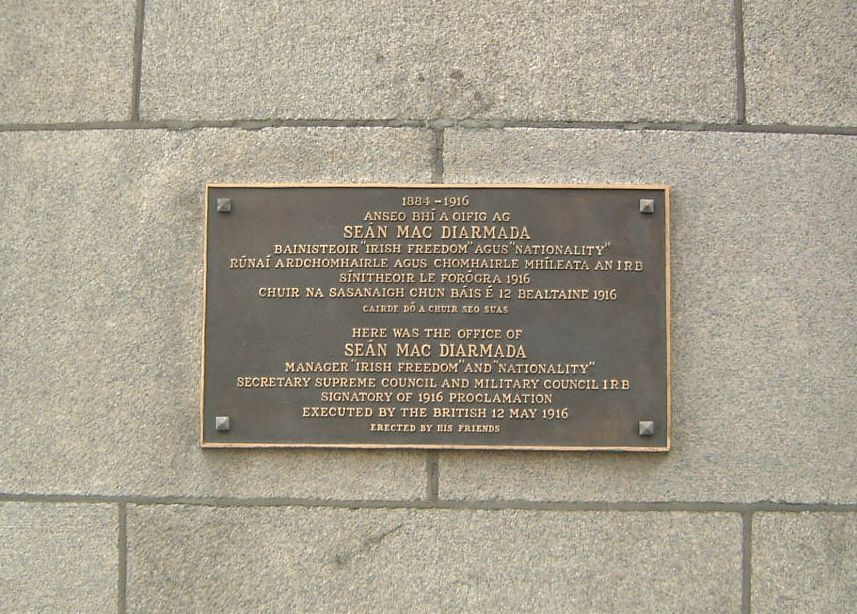
At the time of the republican proclamation, Thomas Clarke was the leader of the Irish Republican Brotherhood (IRB) and a diehard proponent of armed rebellion against British rule in Ireland.15 He worked closely with Sean Mac Diarmada, a leading member of the Brotherhood's Military Committee, alongside the Irish Volunteers' commandant and university lecturer, Thomas MacDonagh.16 Whereas MacDonagh was born in the village of Cloughjordan, County Tipperary, on February 1, 1878, MacDiarmada, his contemporary, was five years younger and from County Leitrim, in the western province of Connacht. In the first full account of the life of this enigmatic revolutionary, Gerald MacAtasney described the depth of MacDiarmada’s impact on Sinn Féin, the IRB, and then the Irish Volunteers.17 A plaque constructed by his friends in Dublin suggests that before MacDiarmada was executed by firing squad on May 12, 1916, the republican activist had served as Secretary Supreme of the IRB Military Council.18 The position earned MacDiarmada some public recognition as one of the managers of the newspapers, Irish Freedom and Nationality. A summary of Brian Feeney’s work showed that MacDiarmada practically “moved in the shadows, ultra-cautious about what he committed to paper, aware that his letters could be intercepted by the police.”19 Such secretiveness would make it difficult for scholars to access the details of his substantial role in planning the Rising. Yet among them all, Pearse appears to have occupied the highest place in the revolutionary ladder. Louis Le Roux, Pearse’s 1930s French biographer, had argued that “[he] was more than a patriot; [Pearse] was a virtuous man. He possessed all the qualities which go to the making of a saint . . . it would not be astonishing if Pearse were canonized someday.”20 Had the Republic of Ireland infinitely failed to exist, Le Roux would probably have sounded different. In any case, Pearse became a recognizable figure for his contributions to learning, but also for rising to political stardom against his father’s Protestant English background.21 Joost Augusteijn’s rigorous study of Pearse firmly established his tedious journey from cultural nationalism to republican violence.22 His childhood was ruled by “an exceptionally vivid imagination” and protective love for his younger brother, Willie.23 By always “riding his wooden horse into battle, or in search of the Holy Grail,” Pearse unknowingly turned the living room into “his own ship or his own kingdom.”24 When Pearse read the declaration of “the rights of the people of Ireland to the ownership of Ireland,” he echoed the reality, demonstrating utmost conviction that such rights, as granted to the people, must come with unfettered control of Irish destinies. The pronouncement strongly resonated with Irishness in ways that not even a totalizing destruction of the Irish people could nullify the solidarity and sovereignty embedded in the proclamation. Through the secessionist announcement, the religious people of Ireland invoked the protection of the Highest God, whose blessings were needed upon the arms and lives of the ‘disciplined and valorous children’ of the soil. Specifically, the religious language was chosen by Pearse and fellow author of the proclamation James Connolly to appeal to the people. Though they did not speak to the general population, they used that language in hopes that the people would accept their cause. In general, these nationalists demonstrated unfamiliar readiness to “sacrifice themselves for the common good.”25
Though he mercifully escaped execution into self-exile, Nigeria’s Ojukwu as several other Biafrans, suffered a similar fate from the second half of the twentieth century.26 By the outbreak of the Nigerian Civil War on July 6, 1967, the land of Biafra, and indeed, the Nigerian federation, was the largest Christian environment in Africa. It was not surprising that Ojukwu equally sealed the Ahiara Declaration of 1st June 1969, with “Oh God, not my will, but Thine forever.”27 The Ahiara document was drafted by a group of intellectuals, including Chinua Achebe, and it became the blueprint for the mission and conduct of Biafrans throughout the Nigerian Civil War.28
Born to a wealthy Igbo entrepreneur on November 4, 1933, Emeka Ojukwu graduated with a bachelor’s degree in History from Oxford University in 1955, and shortly afterwards, joined the Nigerian army.29 When he burnt his British passport in 1960, the year of Nigeria’s independence, Ojukwu’s aim was to turn permanently against “colonialism and neo-colonialism.”30 However, Ojukwu’s faith in ‘the nascent polity called Nigeria’ would begin to decline when divisive sentiments and actions continually outflanked the calls for national unity.
Henceforth, much of Ojukwu’s life was dedicated to the consolidation of Biafran independence as proclaimed on May 30, 1967.31 His strongest words of sober and encouragement went to the ‘proud and courageous Biafrans,’ 32 who must intensify war against the ‘enemies of the East.’33 Like the signatories of the Irish Provisional Government who acknowledged the possibility of a violent imperial pushback from the United Kingdom, Ojukwu forewarned his Biafran compatriots about the impending suffering. In the notes that followed in 1967, “if we [Biafrans] are compelled to [go to war] we must be prepared for a period of real sacrifice, hardship, and inconvenience.”34 Indeed, the Igbo were denounced by many other ethnic groups during the war, even as federal military hostilities climaxed with suffocating economic difficulties, disabled external communications, and stringent immigration measures.
Much like the Biafrans, Irish republicans, inspired mightily by the American and French revolutions of the eighteenth century, guaranteed “religious and civil liberty, equal rights and opportunities to all its citizens.” In other words, both the Irish people and Biafrans believed in the pursuit of happiness of the whole nation, cherishing all the children of its parts equally, oblivious of any differences carefully fostered by an alien government.35
Adom Getachew was correct that the Biafran revolutionaries presented their demands as “an extension and expansion of African decolonization.”36 This internationalist perspective was in line with Ojukwu’s claim that Biafra would never betray the Black race; “no matter the odds, we will fight with all our might until Black men everywhere can point with pride to this Republic, standing dignified and defiant, an example of African nationalism triumphant over its many and age-long enemies.”37 As Chima Korieh observed, the Ahiara Declaration shared many similarities with Ujamaa, a socialist system of village cooperatives based on equal opportunity and self-help in Tanzania, during the administration of Julius Kambarage Nyerere in the 1960s.38 Indeed, the socialist appeal of both Ujamaa and the Ahiara Declaration was not well received by the Western Capitalist Powers, including Britain and the United States, during the Cold War. On “Property and the Community,” the secessionists declared thus against the tenets of Western capitalism:
In the New Biafra, all property belongs to the Community. Every individual must consider all he has, whether in talent or material wealth, as belonging to the community for which he holds it in trust. This principle does not mean the abolition of personal property, but it implies that the State, acting on behalf of the community, can intervene in the dispossession of property to the greater advantage of all. Over-acquisitiveness or inordinate desire to amass wealth is a factor liable to threaten social stability, especially in an underdeveloped society in which there are not enough material goods to go round.39
Here, Ojukwu considered that the attachment of “undue value to money and prosperity” if unchecked by the New Biafra Government would come from the accumulation of large private fortunes by some citizens.40 This very socio-economic framework negated the principle of a free market economy, which sees money and prosperity as essential and inevitable consequences of hard work and productivity. Irish republicans such as James Connolly had equally believed in socialism as representing the dominant and conquering force of freedom in their age.41 But the entrenchment of socialism without sustained efforts to attract the support of the Union of Soviet Socialist Republics (USSR) in the 1960s left the final nail on the coffin of the Biafran republic. Yet in its own merit, the Ahiara manifesto at Mbaise in present-day Imo State, stood as one of the most important articulations of political philosophy to emerge from Africa in the post-colonial period. This is because the declaration drew extensively from the conditions of the easterners during the Nigeria-Biafra War.42 The republic of Biafra collapsed by the end of the secessionist crisis in January 1970, but the principles of the revolution have continued to address fundamental issues facing humanity in recent times—including the sanctity of human life, dignity of the human person, social justice, stance against genocide, and the core strength of democratic leadership which defined indigenous Igbo political philosophy and institutions.43 At the macro level of assessing the dynamics of historical causation, the greatest obstacle to the dream of Biafra was neither poor ammunition nor the blockade-engendered famine—not even the Western fear of communist infiltration in Nigeria—the strongest impediment was the enshrined non-negotiable sovereignty of the postcolonial state in the covenant of the United Nations of which the Federal Republic of Nigeria was and remains a supportive member country.
Conclusion and points which Did not fit
The Irish nationalists saw the United Kingdom as their biggest problem, while the Biafran apologists dismissed the Nigerian federation as an unsafe British neocolonial appendage. Both agitations sought the creation of completely independent republics. In the 1960s, radical anticolonialism designated the emergence of new African nations as an ultimate triumph over imperial oppressions. The foundations of vibrant decoloniality had been laid in the 1920s, during which Irish nationalists appropriated the idea of self-determination as contained in Woodrow Wilson’s Fourteen Points. In the immediate aftermath of World War I, European powers were addressed in specific terms: “We entered this war because violations of right had occurred,” began the 28th U.S. President,
“What we demand…therefore, is nothing peculiar to ourselves. It is that the world be made fit and safe to live in; and particularly that it be made safe for every peace-loving nation which, like our own, wishes to live its own life, determine its own institutions, [and] be assured of justice and fair dealing by the other peoples of the world as against force and selfish aggression.”44
The fifth clause advocated an “absolutely impartial adjustment of all colonial claims, based upon a strict observance of the principle that in determining…questions of sovereignty the interests of the populations concerned must have equal weight with the equitable claims of the government whose title is to be determined.”45 A combination of factors, including the guerrilla warfare conducted by the Irish Republican Army (IRA) against Crown forces during the War of Independence, accounted for the denial of attention to Irish delegates to the Versailles Peace Conference of early January 1919. Yet, internationalism, the doctrine of seeking an appeal to the Wilsonian moment, was embodied in the Dáil Éireann’s Message to the Free Nations of the World, which was published on January 21, 1919.46 Wilson’s Fourteen Points speech gave little thought to the application of national self-determination beyond Europe, but his framework of an international order of democratic states supplied
A new language that came to underpin revolutionary challenges to the old order. The belief that their cause could be placed before the international community undermined the legitimacy of empires, encouraging nationalists to reject their offers of limited reform in favor of full independence.47
The claims of Irish revolutionaries to the motivations and influence of the dead generations were as legitimizing as the ensuing chastisement of empires. It may be instructive to note that the men who signed the Proclamation did not have a wide audience before 1916. Pearse was a nonviolent activist until about 1912-13, and he became radicalized in those years as an advocate of physical force. Tom Clark and Mac Diarmada were the central figures in the IRB, around whom Pearse, Mac Donagh, and others eventually coalesced. Like the socialist James Connolly, all the signatories of 1916 were executed by the British Army firing squad for their part in the Rising, so they would play no role in the events after.48 Thus, their ideas would be taken up by other revolutionaries with potentially different agendas. Basically, the Irish War of Independence lasted from 1919-21,49 and its major outcome was the establishment of the Republic of Ireland.
For the Biafrans, historian Roy Doron provided a detailed trajectory of their plight after the aborted revolution of January 15, 1966.50 The coup d’etat was expected to deliver Nigeria’s first republic from manifold corruption and install leaders believed to possess greater potential for accountability, economic transformation, protection of human rights and tolerance for public criticism.51 Alhaji Tafawa Balewa, the incumbent Prime Minister, was assassinated by the revolutionaries under the leadership of Chukwuma Kaduna Nzeogwu, a brilliant Igbo officer and the first Nigerian to be trained in military intelligence in the Royal Military Academy at Sandhurst.52 Ethnic interpretations characterized the immediate post-coup period, and political commentators, chiefly from Northern Nigeria, labeled the revolution an Igbo inclination to dominate. The suspicion seemed rational, especially because the coup plotters captured neither Michael Opara, Kingsley O. Mbadiwe, nor Nnamdi Azikiwe—prominent Nigerian politicians of Igbo extraction at the time. In fact, of the about twenty-two casualties in the putsch, only Arthur Chinyelu Unegbe was of Igbo origin; the rest of the assassinated leaders came from either the Yoruba, Hausa/Fulani, or lesser-known middle belt ethnic groups in Nigeria. Thus, a counter coup occurred on January 29, 1966. The plotters killed the emergent Head of State, Johnson Aguiyi Ironsi, an Igbo General who had introduced the controversial political centralization decree number 34.53 As the chains of absurdity culminated in the pogrom—massacre of the Igbo, and ultimately, civil war, members of the international community could not recognize the Biafran claims to genocide. The indifference happened probably because the killings were not executed under the flag of any global empire.
In Ireland, the emotive nature of the public debate, engagement, and sense of national identification with the Biafran cause had a surprisingly infinitesimal impact on Dublin’s decision to remain neutral.54 Fiona Bateman wrote that parallels of suffering were drawn between Biafra and Tudor Ireland. In utmost sympathy with the starving Biafrans in 1968, the Irish Press invoked Edmund Spenser’s eyewitness account of the nineteenth-century famine in Ireland. The column reminisced that “out of every corner of the woods and glens they came, creeping forth on their hands, for their legs would not bear them: they looked like anatomies of death, they spoke like ghosts crying out of their graves.”55 Bateman is based in the Huston School of Film and Digital Media at NUI Galway.56 The touching illustrations from her chapter confirmed that the impact of the Nigeria-Biafra War was profound in Ireland, especially given the war’s propaganda intersection with diplomatic correspondence, media politics, and the complexities of modern global relationships and religion.57 Historian Enda Staunton summarized that the war “reverberate[d] across the world, causing a response in Ireland unequalled by the reaction to any civil conflict between that of Spain in the 1930s and that of Yugoslavia in the 1990s.” In other words, the conflict brought about “the greatest emotional involvement with an African problem since Ireland’s participation in the Congo Conflict.58 Conversely, the impact of Ireland’s participation in the Nigeria-Biafra War may be exaggerated, as not even a temporary office was granted to Biafra by Francis Thomas Aiken, who served as Minister for External Affairs throughout much of the period of conflict.59 In contrast to Ireland’s subversive past, Aiken consistently rejected the argument for Igbo independence. He considered that to allow a single tribe to hive off on its own would encourage the remaining hundreds of ethnic groups to demand autonomy from the Nigerian state.60 Born as the youngest of seven on February 13, 1898, Frank Aiken strongly believed that dreadful things happen in wars, and worse during civil wars.61 Thus, despite Dublin’s non-recognition policy, the people of Ireland were favorably forthright with humanitarian aid, which flowed through the Catholic missionaries. Not only was Ireland’s only African embassy in Lagos,62 but Nigeria has also been perfunctorily classified as the showpiece of Ireland’s religious empire.63 In fact, “the greatest concentration of Irish missionaries in the entire world was to be found there. Of [Nigeria’s] 850 Catholic priests, more than 500 were Irish; the Irish church ran 2,419 primary schools, catering for 561,318 pupils; twice as many as in the remainder of Africa [and] the 47 religious-run hospitals serving 714,441 patients.”64 Irish people equally dominated the bishoprics of Calabar, Benin, Ibadan, Ogoja, Kaduna, Owerri, and other cities in Nigeria.65
But beyond Ireland, the cooperation between Christians and Judaists was generally unprecedented. The Catholic Advance, a Kansas-based newspaper, reported in 1968 that the response of the religious communities in the United States and overseas to the plight of the victims of the Nigeria-Biafra imbroglio was enormous.66 The deputy director of the United Nations Children’s Fund (UNICEF) acknowledged the sustained supply of food and drugs to Biafra as a landmark in understanding the true relevance of religion to humanity. The UN official also appreciated the significance of faith, wondering how much greater the human tragedy would have been had the missionaries not been actively engaged in addressing the problems of famine and displacement.67 James Ahern, one of the Irish priests who fled Biafra in the middle of the conflict, helped to internationalize the predicament. According to him, the name, Biafra, became synonymous with “images of death, wanton destruction, and human suffering, almost beyond description.”68 During this period, the Biafrans were confronted with the possibility of total annihilation; the Red Cross recorded a death toll of 42,000 persons per week, the bulk of whom included women and children. Nigerian historian Chima Korieh described the civil war as “the first black-on-black genocide in postcolonial Africa,” causing massive numbers of civilian deaths, devastation of public bridges, schools, roads, towns, and hospitals.69 In the Santa Cruz Sentinel, Hugh A. Mulligan, the New York-born journalist, summarized that ‘death,’ as of November 1968, was an everyday way of life, especially in Umuahia, the new capital of the faltering republic. “Like the vultures constantly circling in the cloudless tropical sky, [death] casts its shadow everywhere; on soldiers, on civilians, most of all on children who [died] at a rate [unknown] even in the madness of modern warfare.”70 The figures are still being contested, but the most popular ones peg the total death toll at two million Nigerians, most of whom came from the Igbo-speaking population. Despite all the suffering, the Republic of Biafra still crumbled, and Bruce Mayrock’s protest suicide of May 1969 in New York could not stir the United Nations.71
Bibliography
Ademoyega, Adewale. Why We Struck: The Story of the First Nigerian Coup. Ibadan: Evans Brothers, 1981.
Augusteijn, Joost. Patrick Pearse: The Making of a Revolutionary. New York: Palgrave Macmillan, 2010.
Bartlett, Thomas, “The 1798 Irish Rebellion,” BBC Website, last updated 2011-02-17. BBC - History - British History in depth: The 1798 Irish Rebellion
Beiner, Guy. Remembering the Year of the French: Irish Folk History and Social Memory. Madison: The University of Wisconsin Press, 2007.
Bosco, David. “Exorcising the United Nations,” a review of No Enchanted Palace: The End of Empire and the Ideological Origins of the United Nations by Mark Mazower, Diplomatic History, Vol. 35, No. 5 (NOVEMBER 2011), 921.
Buettner, Elizabeth. “How Unique is Britain’s Empire Complex?” In Stuart Ward and Astrid Rasch, editors, Embers of Empire in Brexit Britain. London: Bloomsbury Academic, 2019.
Charter of the United Nations and Statute of the International Court of Justice, San Francisco, 1945. uncharter.pdf
Coleman, Marie, The Irish Revolution, 1916-1923. London & New York: Routledge, 2014.
Cuttino, G. P. “Medieval Parliament Reinterpreted,” Speculum, Vol. 41, No. 4 (October 1966): 681–682.
“Death Is an Everyday Way of Life in Biafra,” Santa Cruz Sentinel (Santa Cruz, California), Monday, November 11, 1968, downloaded on March 23, 2024.
Dorney, John. “The Irish War of Independence – A Brief Overview,” The Irish
Story, 18 September 2012. Accessed 11/17/2025.
Doron, Roy. Biafra: A Military History. Bloomington: Indiana University Press,
2025.
Edwards, Ruth Dudley. Patrick Pearse: The Triumph of Failure. London: Victor
Gollancz Ltd., 1990.
Elkins, Caroline. Legacy of Violence: A History of the British Empire. New York: Alfred A. Knopf, 2022.
--------Imperial Reckoning: The Untold Story of Britain’s Gulag in Kenya (New York: Henry Holt and Company, 2005).
Evan, Bryce, & Kelly, Steven, editors. Frank Aiken: Nationalist and Internationalist. Kildare: Irish Academic Press, 2014.
Ezeuwa, Kingsley C. Remembering 1982: Willful Forgetting, Reconciliation and Partitioned Memory in Post-Civil War Nigeria (M.A. Essay, Department of History, Marquette University, 2023).
Flannery, Eoin. “Irish Cultural Studies and Postcolonial Theory.” Postcolonial Text Vol 3 No 3 (2007).
Getachew, Adom. Worldmaking after Empire: The Rise and Fall of Self-Determination. Princeton & Oxford: Princeton University Press, 2019.
Gildea, Robert. Empires of the Mind: The Colonial Past and the Politics of the Present. New York: Cambridge University Press, 2019.
Harkins, Shaun, ed. The James Connolly Reader. Chicago: Haymarket Books,
2018.
“History of Parliament in Ireland,” Houses of Oireachtas History of Parliament in Ireland – Houses of the Oireachtas. Accessed 4/10/2024.
“Horror in Biafra Seen by Matean.” The Times (San Mateo, California), Friday, September 6, 1968, page 53, downloaded on March 23, 2024.
Häussler, Matthias. The Herero Genocide: War, Emotion, and Extreme Violence in Colonial Namibia, translated from the German by Elizabeth Janik. New York: berghahn, 2021.
Ikpe, Ukana B. “Patrimonialism and Military Regimes in Nigeria.” African Journal of Political Science, Vol. 5, No. 1 (June 2000): 146–162.
Ireland and the Versailles Peace Conference,” Dáil 100 Éireann. https://www.dail100.ie/en/long-reads/ireland-and-the-versailles-peace-conference/
Kanter, Douglas. “The Foxite Whigs, Irish Legislative Independence and the Act of Union, 1785-1806.” Irish Historical Studies, Vol. 36, No. 143 (May 2009), 332–348.
Kelly, James. “The Origins of the Act of Union: An Examination of Unionist Opinion in Britain and Ireland, 1650-1800.” Irish Historical Studies, Vol. 25, No. 99 (May 1987): 236–263.
Kennedy, W. P. M. “Significance of the Irish Free State.” The North American Review, Vol. 218, No. 814 (Sep. 1923): 316–324.
Knirck, Jason. Afterimage of the Revolution: Cumann na nGaedheal and Irish Politics, 1922-1932. Madison: The University of Wisconsin Press, 2014.
Korieh, Chima J. New Perspectives on the Nigeria-Biafra War: No Victor, No Vanquished. Lanham: Lexington Books, 2021.
-------The Nigeria-Biafra War: Genocide and the Politics of Memory. New York: Cambria, 2012.
Magennis, Eoin. A review of Sean MacDiarmada: The Mind of the Revolution
by Gerald MacAtasney. Manorhamilton: Drumlin Publications, 2004. Seanchas Ardmhacha: Journal of the Armagh Diocesan Historical Society, Vol. 20, No. 2 (2005): 357–358.
Maier, Charles S. “Empire’s Past…Empire’s Future,” South Central Review, Vol. 26, No. 3 (Fall 2009): 2–19.
Mazower, Mark. No Enchanted Palace: The End of Empire and the Ideological Origins of the United Nations. Princeton and Oxford: Princeton University Press, 2009.
McGarry, Fearghal. “Ireland of the Far East?”: The Wilsonian Moment in Korea and Ireland,” in Patrick Mannion and Fearghal McGarry, The Irish Revolution: A Global History. New York: New York University Press, 2022.
McMahon, Timothy G. Grand Opportunity: The Gaelic Revival and Irish Society, 1893-1910. New York: Syracuse University Press, 2008.
Muschalek, Marie. Violence as Usual: Policing and the Colonial State in German Southwest Africa. Ithaca and London: Cornell University Press, 2019.
Mustapha, Shakir. “Revisionism and Revival: A Postcolonial Approach to Irish Cultural Nationalism,” New Hibernia Review / Iris Éireannach Nua, Vol. 2, No. 3 (Autumn, 1998): 36-53.
Nyerere, Julius K. “Ujamma—The Basis of African Socialism,” reprinted copy available at www.jpanafrican.org/edocs/e-DocUjamma3.5.pdf
Ojukwu, Emeka, Ahiara Declaration: The Principles of the Biafran Revolution, with an introduction by Chima J. Korieh (Glassboro: Goldline and Jacobs Publishers, 2021), 131.
------Because I am Involved. Ibadan: Spectrum Books, 1989.
------Biafra; selected speeches and random thoughts of C. Odumegwu Ojukwu. New York: Harper & Row, 1969.
Omaka, Arua Oko. “Through Imperial Lens: The Role of Portugal in the Nigeria-Biafra War.” Journal of Global South Studies, Vol. 36, No. 1, (Spring 2019): 186-209.
Plaque outside offices in Dublin once used by Seán MacDiarmada https://upload.wikimedia.org/wikipedia/commons/a/af/Se%C3%A1n_Mac_Diarmada_plaque.jpg
Post, Gains. “Plena Potestas and Consent in Medieval Assemblies: A Study in Romano-Canonical Procedure and the Rise of Representation, 1150-1325,” Traditio, 1943, Vol. 1 (1943): 355-408.
Proclamation of the Irish Republic,” document available at the National Museum of Ireland. The Proclamation of the Irish Republic | National Museum of Ireland
Satia, Priya. Time’s Monster: How History Makes History. Cambridge: The Belknap of Harvard University Press, 2020.
Staunton, Enda. “The Case of Biafra: Ireland and the Nigerian Civil War.” Irish Historical Studies, Vol. 31, No. 124 (November 1999): 513–534.
“The Tragedy of Biafra,” The Catholic Advance (Wichita, Kansas), Thursday, August 22, 1968. Page 7, downloaded on March 23, 2024.
Thornley, David, “Patrick Pearse” An Irish Quarterly Review, Vol. 55, No. 217 (Spring, 1966): 10-20.
Vann, Michael G. “Of Pirates, Postcards, and Public Beheadings: The Pedagogic Execution in French Colonial Indochina,” Historical Reflections / Réflexions Historiques, Vol. 36, No. 2, (2010): 39–58.
Woodrow Wilson’s ‘Fourteen Points,’ January 8, 1918, as culled from Arthur S. Link et al., eds., The Papers of Woodrow Wilson, vol. 45 (1984), 536 Microsoft Word - Fourteen_Points.doc (purdue.edu)
1 Eoin Flannery, “Irish Cultural Studies and Postcolonial Theory,” Postcolonial Text Vol 3 No 3 (2007): 1. The need to understand Ireland’s nationalism and victory through contemporary comparative lens is also implied in Shakir Mustapha, “Revisionism and Revival: A Postcolonial Approach to Irish Cultural Nationalism,” New Hibernia Review / Iris Éireannach Nua, Vol. 2, No. 3 (Autumn, 1998): 36-53.
2 Insights from Priya Satia, Time’s Monster: How History Makes History (Cambridge: The Belknap of Harvard University Press, 2020), 3.
3 Robert Gildea, Empires of the Mind: The Colonial Past and the Politics of the Present (New York: Cambridge University Press, 2019), 2.
4 ? Caroline Elkins, Legacy of Violence: A History of the British Empire (New York: Alfred A. Knopf, 2022). She had revealed the hidden story of Britain’s brutal suppression of the Mau Mau nationalist rebellion in Kenya in the 1950s. Elkins, Imperial Reckoning: The Untold Story of Britain’s Gulag in Kenya (New York: Henry Holt and Company, 2005). Perhaps, the German empire was worse in the application of violence to achieve colonial objectives. You may read Marie Muschalek, Violence as Usual: Policing and the Colonial State in German Southwest Africa (Ithaca and London: Cornell University Press, 2019), and Matthias Häussler, The Herero Genocide: War, Emotion, and Extreme Violence in Colonial Namibia, translated from the German by Elizabeth Janik (New York: berghahn, 2021); for the French empire, Michael G. Vann, “Of Pirates, Postcards, and Public Beheadings: The Pedagogic Execution in French Colonial Indochina,” Historical Reflections / Réflexions Historiques, Vol. 36, No. 2, (2010): 39-58.
5 Mark Mazower, No Enchanted Palace: The End of Empire and the Ideological Origins of the United Nations (Princeton and Oxford: Princeton University Press, 2009), 63.
6 Mazower, No Enchanted Palace, 20.
7 Charter of the United Nations and Statute of the International Court of Justice, San Francisco, 1945. uncharter.pdf
8 Michael Wood, “Non-Intervention (Non-Interference in domestic affairs), Encyclopedia Princetoniensis, Non-Intervention (Non-interference in domestic affairs) | The Princeton Encyclopedia of Self-Determination
9 Read ‘Introduction: History and the Politics of Memory,” Chima Korieh, editor, The Nigeria-Biafra War: Genocide and the Politics of Memory (New York: Cambria, 2012), the systematized nature of the killing of civilians, including women and children, has compelled some scholars to argue that Nigeria’s Federal Military troops committed a yet-to-be acknowledged genocide against the Igbo, one of the three dominant ethnic groups in the country (the two others are Yoruba and Hausa/Fulani. In total Nigeria has about 200 known ethnic groups).
10 David Bosco, “Exorcising the United Nations,” a review of No Enchanted Palace: The End of Empire and the Ideological Origins of the United Nations by Mark Mazower, Diplomatic History, Vol. 35, No. 5 (November 2011): 921.
11 James Pearse, an originally Protestant English sculptor.
12Roy F. Foster, Vivid Faces, 6, digital copy.
13 ? Ruth Dudley Edwards, Patrick Pearse: The Triumph of Failure (London: Victor Gollancz Ltd., 1990), 19.
14 “Proclamation of the Irish Republic,” document available at National Museum of Ireland. The Proclamation of the Irish Republic | National Museum of Ireland
15 Clarke had spent 15 years in prison in Britain for attempting to bomb the London Bridge in the 1880s. His return to Ireland in 1907 shaped the resuscitation of the IRB and coincided with the rise of the ‘revolutionary generation.’ Coleman, The Irish Revolution, 15. See also: https://www.irishcentral.com/roots/history/tom-clarke-easter-rising
16 https://www.irishcentral.com/roots/history/tom-clarke-easter-rising
17 ? Eoin Magennis, a review of Sean MacDiarmada: The Mind of the Revolution by Gerald MacAtasney (Manorhamilton: Drumlin Publications, 2004), Seanchas Ardmhacha: Journal of the Armagh Diocesan Historical Society, Vol. 20, No. 2 (2005): 357-358.
18 Plaque outside offices in Dublin once used by Seán MacDiarmada https://upload.wikimedia.org/wikipedia/commons/a/af/Se%C3%A1n_Mac_Diarmada_plaque.jpg
19 ? Brian Feeny, Sean MacDiarmada: 16 Lives (The O’Brien Press, 2014).
20David Thornley, “Patrick Pearse” An Irish Quarterly Review, Vol. 55, No. 217 (Spring, 1966): 10-20.
21Thornley, “Patrick Pearse,” 10.
22 ? Joost Augusteijn, Patrick Pearse: The Making of a Revolutionary (New York: Palgrave Macmillan, 2010).
23 ? Edwards, Patrick Pearse, 6 & 11
24 ?Edwards, Patrick Pearse, 6.
25The Easter Proclamation document.
26See Kingsley C. Ezeuwa, Remembering 1982: Willful Forgetting, Reconciliation and Partitioned Memory in Post-Civil War Nigeria (M.A. Essay, Department of History, Marquette University, 2023).
27 Emeka Ojukwu, Ahiara Declaration: The Principles of the Biafran Revolution, with an introduction by Chima J. Korieh (Glassboro: Goldline and Jacobs Publishers, 2021), 131.
28 July 1967, to January 15, 1970. See Arua Oko Omaka, “Through Imperial lens: The Role of Portugal in the Nigeria-Biafra War,” Journal of Global South Studies, Vol. 36, No. 1, (Spring 2019): 187.
29International Past Leaders’ Profiles, “Odumegwu Ojukwu, Chukwuemeka (Nigeria)” doi: 10.1057/978-1-349-95839-9_1 ++ (springer.com)
30 ?Emeka Odumegwu-Ojukwu, Because I am Involved (Ibadan: Spectrum Books Limited, 1989), x.
31 The Ahiara Declaration that followed was simply a consolidation document.
32Ojukwu, Ahiara Declaration, 131.
33Ojukwu, Biafra; selected speeches and random thoughts of C. Odumegwu Ojukwu (New York: Harper & Row, 1969), 146.
34Ojukwu, Biafra; selected speeches and random thoughts, 174.
35 Easter Proclamation document.
36 Adom Getachew, Worldmaking after Empire: The Rise and Fall of Self-Determination (Princeton & Oxford: Princeton University Press, 32019), 126, digital copy.
37 Ojukwu, Ahiara Declaration, 133-134.
38 See ‘introduction’ in Ojukwu, Ahiara Declaration, 2; Julius K. Nyerere’s original draft available as “Ujamma—The Basis of African Socialism,” www.jpanafrican.org/edocs/e-DocUjamma3.5.pdf
39 Ojukwu, Ahiara Declaration, 104.
40 Ibid, 105.
41 ? Shaun Harkins, ed., The James Connolly Reader (Chicago: Haymarket Books, 2018).
42 See Korieh’s introduction to the redeemed version of the Ahiara Declaration, 3
43 Ojukwu, Ahiara Declaration, 3.
44 Woodrow Wilson’s ‘Fourteen Points,’ January 8, 1918, as culled from Arthur S. Link et al., eds., The Papers of Woodrow Wilson, vol. 45 (1984), 536 Microsoft Word - Fourteen_Points.doc (purdue.edu)
45 Wilson’s ‘Fourteen Points.’
46 “Ireland and the Versailles Peace Conference,” Dáil 100 Éireann. https://www.dail100.ie/en/long-reads/ireland-and-the-versailles-peace-conference/
47 Fearghal McGarry, “Ireland of the Far East?”: The Wilsonian Moment in Korea and Ireland,” in Patrick Mannion and Fearghal McGarry, The Irish Revolution: A Global History (New York: New York University Press, 2022), 66.
49 ? John Dorney, “The Irish War of Independence – A Brief Overview,” The Irish Story, 18 September 2012. Accessed 11/17/2025.
50 ? Roy Doron, Biafra: A Military History (Bloomington: Indiana University Press, 2025).
51 Ukana B. Ikpe, “Patrimonialism and Military Regimes in Nigeria,” African Journal of Political Science, Vol. 5, No. 1 (June 2000): 152.
52 Adewale Ademoyega, Why We Struck: The Story of the First Nigerian Coup (Ibadan: Evans Brothers, 1981), 65.
53Ojukwu, Because I am Involved, 10.
54 Fiona Bateman, “Ireland and Biafra: Hunger, History, Politics, and Public Opinion,” in Chima J. Korieh, editor, The Nigeria-Biafra War: Genocide and the Politics of Memory (New York: Cambria, 2012), 111.
55 Bateman, “Ireland and Biafra,” 11. See also: https://www.irishtimes.com/culture/heritage/how-ireland-got-involved-in-a-nigerian-civil-war-1.3089229
56 https://mooreinstitute.ie/2020/06/26/africa-and-blackness-in-the-irish-imagination/
57 Bateman, “Ireland and Biafra,” 111-132.
58Enda Staunton, “The Case of Biafra: Ireland and the Nigerian Civil War,” Irish Historical Studies, Vol. 31, No. 124 (November 1999), 513.
59 Staunton, “The Case of Biafra,” 517-518.
60 Staunton, “The Case of Biafra,” 517.
61 Bryce Evan and Steven Kelly, editors, Frank Aiken: Nationalist and Internationalist (Kildare: Irish Academic Press, 2014), xvi.
62 Embasáid na hÉireann first established September 1960. https://www.ireland.ie/en/nigeria/abuja/about/embassy-history/
63 Staunton, “The Case of Biafra,” 513.
64 Ibid, 513.
65 Ibid, 516.
66 “The Tragedy of Biafra,” The Catholic Advance (Wichita, Kansas), Thursday August 22, 1968. Page 7, downloaded on March 23, 2024.
67 “The Biafra Tragedy,” The Catholic Advance, page 7.
68Horror in Biafra Seen by Matean,” The Times (San Mateo, California), Friday, September 6, 1968, page 53, downloaded on March 23, 2024.
69 Korieh, editor, The Nigeria-Biafra War, 2
70 “Death Is an Everyday Way of Life in Biafra,” Santa Cruz Sentinel (Santa Cruz, California), Monday, November 11, 1968, downloaded on March 23, 2024.
71Korieh, ed. New Perspectives on the Nigeria-Biafra War: No Victor, No Vanquished (Lanham: Lexington Books, 2021), xvi.