The Language of War: Minsk, Istanbul and Islamabad as Consequential Missed Opportunities for Peace in the Ukraine and Iran Wars
This article compares the Minsk agreements, the 2022 Istanbul negotiations and the 2026 Islamabad-mediated United States–Iran ceasefire process as consequential opportunities to contain or end war. Building on the Language of Wars Project’s examination of how wartime vocabulary and strategic narratives shape policy, the article finds that the words, metaphors and strategic narratives used to describe conflict shape the policies governments consider legitimate and the compromises they consider politically acceptable. The rhetoric of victory, credibility, maximum pressure and strategic defeat repeatedly displaced the practical language of sequencing, reciprocity, verification and enforceable guarantees. Each missed opening allowed Russia or Iran to adapt, acquire new leverage and demand more favourable terms, while the United States and Europe accumulated military, economic and diplomatic costs. The comparison does not absolve Russia or Iran of aggression or coercive conduct. It shows that justified opposition to an adversary does not remove the strategic necessity of credible diplomacy.
Abstract
This article compares the Minsk agreements, the 2022 Istanbul negotiations and the 2026 Islamabad-mediated United States–Iran ceasefire process as consequential opportunities to contain or end war. Building on the Language of Wars Project’s examination of how wartime vocabulary and strategic narratives shape policy, the article finds that the words, metaphors and strategic narratives used to describe conflict shape the policies governments consider legitimate and the compromises they consider politically acceptable. The rhetoric of victory, credibility, maximum pressure and strategic defeat repeatedly displaced the practical language of sequencing, reciprocity, verification and enforceable guarantees. Each missed opening allowed Russia or Iran to adapt, acquire new leverage and demand more favourable terms, while the United States and Europe accumulated military, economic and diplomatic costs. The comparison does not absolve Russia or Iran of aggression or coercive conduct. It shows that justified opposition to an adversary does not remove the strategic necessity of credible diplomacy.
Keywords: Ukraine; Iran; Minsk agreements; Istanbul negotiations; Islamabad mediation; Strait of Hormuz; language of war; coercive diplomacy; strategic communication; security guarantees; missed opportunities for peace
1. INTRODUCTION: THE LANGUAGE THAT MAKES PROLONGED WAR POSSIBLE
Wars are fought with artillery, missiles, aircraft, drones, blockades, sanctions and industrial production. They are also fought through verbs, metaphors and strategic narratives. Governments promise to “degrade,” “crush,” “annihilate” or permanently neutralize an adversary. They invoke “credibility,” “maximum pressure,” “peace through strength” and the need to impose a “strategic defeat.” Such language does more than describe policy. It defines the outcomes that military force is expected to produce.
The central insight of the Language of Wars Project is that language is not an ornamental accompaniment to strategy. It shapes expectations, narrows the range of politically acceptable choices and determines whether compromise can be presented as prudence or denounced as weakness. Once victory is defined as the adversary’s military exhaustion, political transformation or effective surrender, an imperfect settlement is no longer compared with the likely consequences of continued war. It is compared with an imagined decisive victory.
This article examines three diplomatic moments represented by three cities: Minsk, Istanbul and Islamabad. Minsk sought to contain the conflict in eastern Ukraine after 2014. Istanbul explored Ukrainian neutrality and international security guarantees during the opening weeks of Russia’s 2022 invasion. Islamabad became the centre of Pakistan’s mediation in the 2026 United States–Iran war, including the April ceasefire and the process that led to the June memorandum of understanding.
These episodes were not identical. Minsk produced signed agreements but no common understanding of implementation. Istanbul produced significant draft compromises but no final settlement. Islamabad created temporary restraint without resolving the nuclear dispute or the future of navigation through the Strait of Hormuz. They nevertheless reveal the same strategic failure: negotiation was repeatedly treated less as a means of constructing peace than as an instrument for improving military position.
The consequences were cumulative. After Minsk, Russia distrusted Western-backed guarantees and Ukraine distrusted settlements that left Russian leverage intact. After Istanbul, continued war allowed Russia to occupy more territory, expand war production and increase the price of a later settlement. After the United States withdrew from the Joint Comprehensive Plan of Action (JCPOA), Iran discounted American commitments. That distrust deepened when Israel attacked Iran in June 2025 while a further round of United States–Iran nuclear negotiations was scheduled, and the United States subsequently joined what President Trump called the “12-Day War.” After the April 2026 ceasefire was followed by intensified maritime coercion, Iran developed greater leverage over the Strait of Hormuz. By the June memorandum and subsequent talks, the terms of possible peace were already less favourable to the United States than they had been in April. The argument is not that Russia and Iran are innocent actors or that Western governments alone caused either conflict. The narrower argument is that opposing aggression does not eliminate the need for credible diplomacy. On the contrary, the more capable an adversary is of adaptation and retaliation, the more consequential each lost opportunity for peace becomes.
2. THE LANGUAGE OF WARS PROJECT: TERMS, CONCEPTS AND STRATEGIC NARRATIVES
The Language of Wars Project is an ongoing corpus-based study of the terminology and conceptual structures through which contemporary wars are explained, justified and contested. Its principal focus is the geopolitical discourse surrounding the wars involving Ukraine and Iran, although its analytical framework is intended to support broader comparative research on armed conflict, diplomacy and international security.
The project brings together official speeches, government statements, diplomatic communications, political interviews, social-media posts and selected media texts. Its corpus includes discourse produced by the United States, Russia, Ukraine, Iran, Israel and other governments and political actors involved in these conflicts. Particular attention is given to presidential and executive communication, including messages issued by the White House and the Kremlin, statements by Ukrainian, Iranian and Israeli leaders, and political discourse circulated through platforms such as Truth Social.
The project draws on terminology studies, lexicology, corpus linguistics, stylistics, pragmatics and political discourse analysis. It treats the vocabulary of war not simply as a collection of frequently occurring words but as a system of concepts through which political actors define reality. Terms such as war, peace, security, sovereignty, invasion, terrorism, ceasefire, escalation, deterrence, aggression, freedom and negotiation do not possess politically neutral meanings. Their significance changes according to the speaker, intended audience, institutional setting and strategic purpose of the communication.
A central concern of the project is the relationship between terms and concepts. Terminological analysis can approach this relationship from two complementary directions: onomasiology and semasiology. These perspectives build on my earlier work on the term–concept relationship, complex terminological units, conceptual ontology and lexicalization in specialized discourse (Igwe 2005; Aito and Igwe 2011; Igwe 2012; Igwe 2015).
Onomasiological analysis begins with a concept or domain of knowledge and examines the different terms, expressions and formulations through which speakers, institutions or communities represent it. It moves from concept to term. A concept such as victory, for example, may be expressed through terms and formulations such as triumph, strategic success, defeat of the enemy, capitulation, regime change or complete victory. These expressions do not necessarily denote identical outcomes. Rather, they reveal how actors select particular lexical forms to intensify, narrow or morally frame a strategic objective.
Semasiological analysis begins with a term or expression found in discourse and examines the concepts, senses and connotations it activates across speakers, institutions and contexts. It moves from term to concept. The term security, for example, may refer to national security, military security, human security, energy security, collective security or regime security. Its practical meaning depends on who uses it, which population or institution is being protected, what danger is being identified and which policy is being justified.
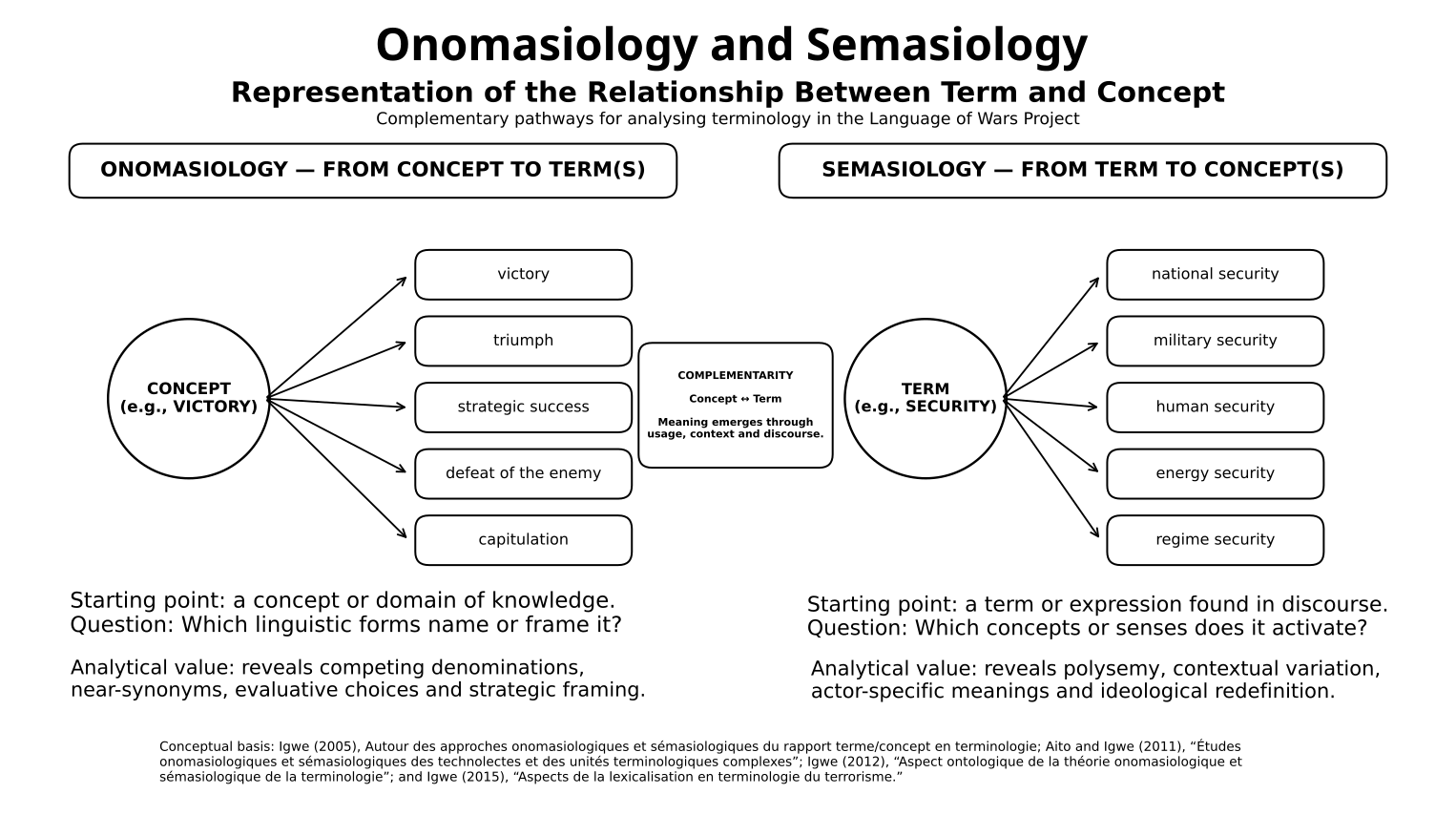
Figure 1. Onomasiology and Semasiology: Representation of the Relationship Between Term and Concept
Figure 1 represents the complementary movement between these two analytical perspectives. Onomasiology maps the range of linguistic choices available for expressing a concept, while semasiology maps the range of meanings that a particular term acquires through actual usage. Neither direction is sufficient on its own. A concept may be expressed through several competing terms, and a single term may activate different or even contradictory concepts. Meaning emerges through the interaction of lexical choice, discourse context, institutional authority, intended audience and strategic purpose.
This complementarity is especially important in the discourse of war. A military action may be described as aggression, retaliation, deterrence, self-defence, liberation, pre-emption or an act of war. The material event may remain the same, but each designation assigns responsibility differently and activates a different moral and legal framework. Likewise, a pause in fighting may be described as a ceasefire, humanitarian measure, tactical interruption, surrender, de-escalation or opportunity to regroup. These choices are not merely stylistic. They establish legitimacy, structure public interpretation and shape which responses appear politically reasonable.
Multiword terms and recurring formulations are therefore central to the project. Expressions such as strategic defeat, maximum pressure, peace through strength, rules-based international order, unprovoked aggression, existential threat, terrorist regime and complete victory compress complex political judgments into apparently self-evident formulas. Through repetition, they can transform contested policy choices into moral imperatives. They may also obscure the distinction between a limited, verifiable objective and an expansive political ambition whose achievement cannot be clearly measured.
The relationship between term and concept is consequently not fixed. Governments and political actors compete not only over territory, military advantage and diplomatic outcomes but also over the language through which those struggles are understood. A state may seek to establish its preferred designation as the authoritative description of an event. The acceptance of terms such as invasion, counterterrorism, resistance, proxy war, occupation or self-defence can influence legal interpretation, alliance solidarity, public opinion and the political acceptability of negotiation.
This framework is especially relevant to the study of missed opportunities for peace. Negotiations depend on practical concepts such as sequencing, reciprocity, verification, implementation, monitoring and enforceable guarantees. War discourse, by contrast, often privileges concepts such as credibility, strength, punishment, dominance, humiliation and victory. When the vocabulary of coercion displaces the vocabulary of implementation, compromise becomes difficult to describe as anything other than weakness.
The present article applies this analytical framework to Minsk, Istanbul and Islamabad. It examines how expressions such as strategic defeat, maximum pressure, peace through strength and coercive credibility influenced the interpretation of diplomatic openings. It also examines how concepts such as security, sovereignty, neutrality, guarantees, victory and peace were expressed differently by competing actors.
The argument is not that rhetoric alone caused negotiations to fail. Material interests, battlefield conditions, alliance commitments, domestic politics and accumulated distrust remained decisive. Language nevertheless helped determine which risks were emphasized, which compromises were discredited and which imagined victories appeared sufficiently plausible to justify continuing war.
The Language of Wars Project therefore treats language as part of strategic power itself. Political vocabulary does not simply report military events after they occur. It helps governments identify enemies, define objectives, distribute responsibility, legitimize escalation and determine when negotiation becomes acceptable. It also helps explain why an imperfect peace may be rejected in favour of a supposedly better future settlement that never arrives.
3. PEACE OPPORTUNITIES AND INSTRUMENTAL DIPLOMACY
A missed opportunity for peace is not necessarily a completed treaty awaiting signature. Draft agreements often conceal unresolved disputes, and a ceasefire may fail without proving that peace was ever guaranteed. A peace opportunity exists when the parties begin to recognize the costs of continued war, identify interests that can be protected without total victory, engage mediators or guarantors and develop language through which compromise can be defended domestically.
Negotiations may serve three overlapping purposes. A constitutive negotiation attempts to create a new political order. A transactional negotiation secures limited exchanges or temporary restraint. An instrumental negotiation is used to gain time, consolidate territorial control, divide alliances, rearm or extract concessions that military force has not yet obtained.
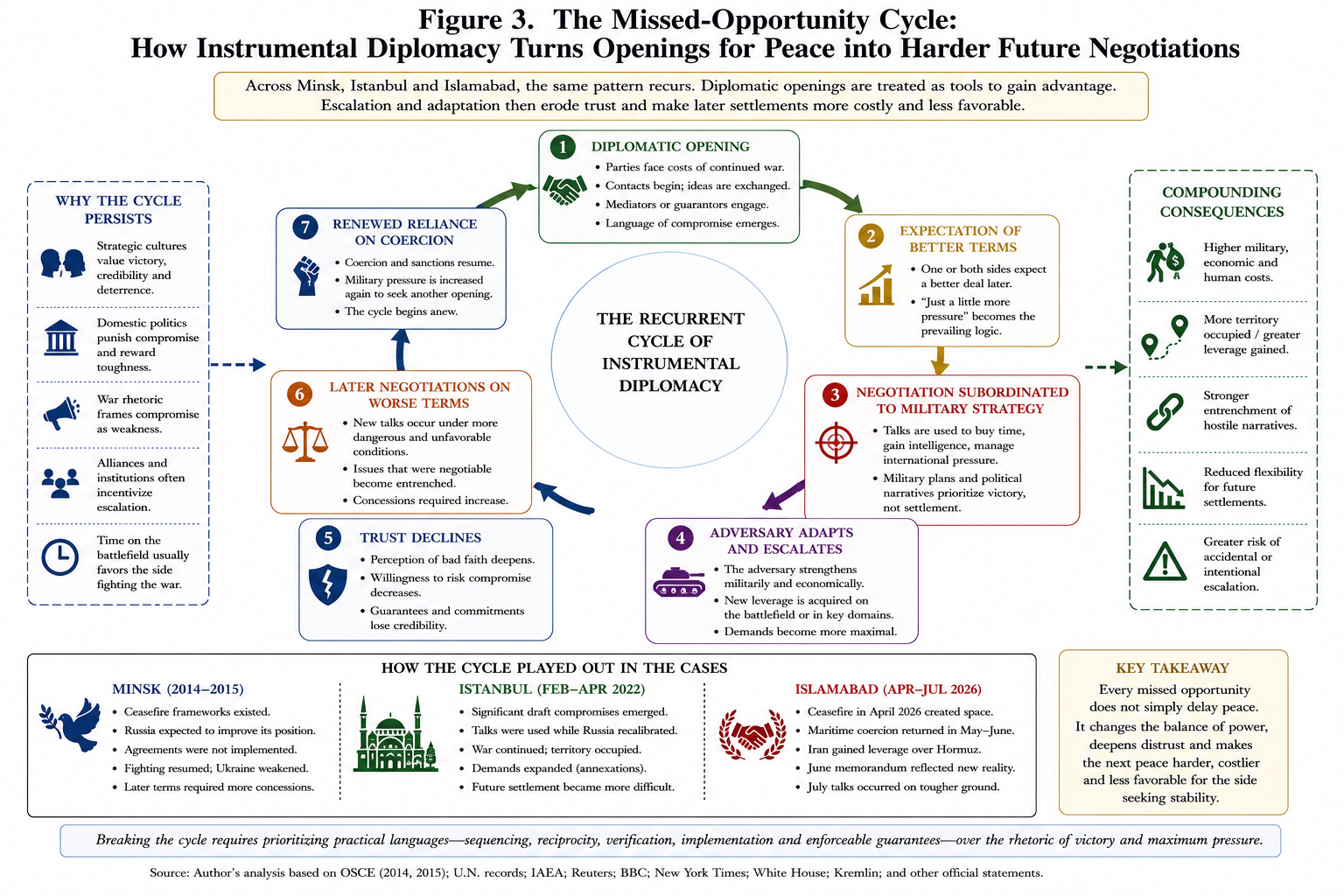
Most diplomacy contains all three elements. A ceasefire can save lives while allowing armies to regroup. The strategic danger arises when the instrumental function overwhelms the peace-making one. If each party assumes that the other will exploit restraint, compliance becomes irrational. Verification demands expand, guarantees become harder to design and mediators lose authority. The result is a credibility recession in which every failed process makes the next process more difficult and more expensive. Minsk, Istanbul and Islamabad form such a sequence. Each was less a repetition of the previous opportunity than a negotiation conducted after trust had already been depleted.
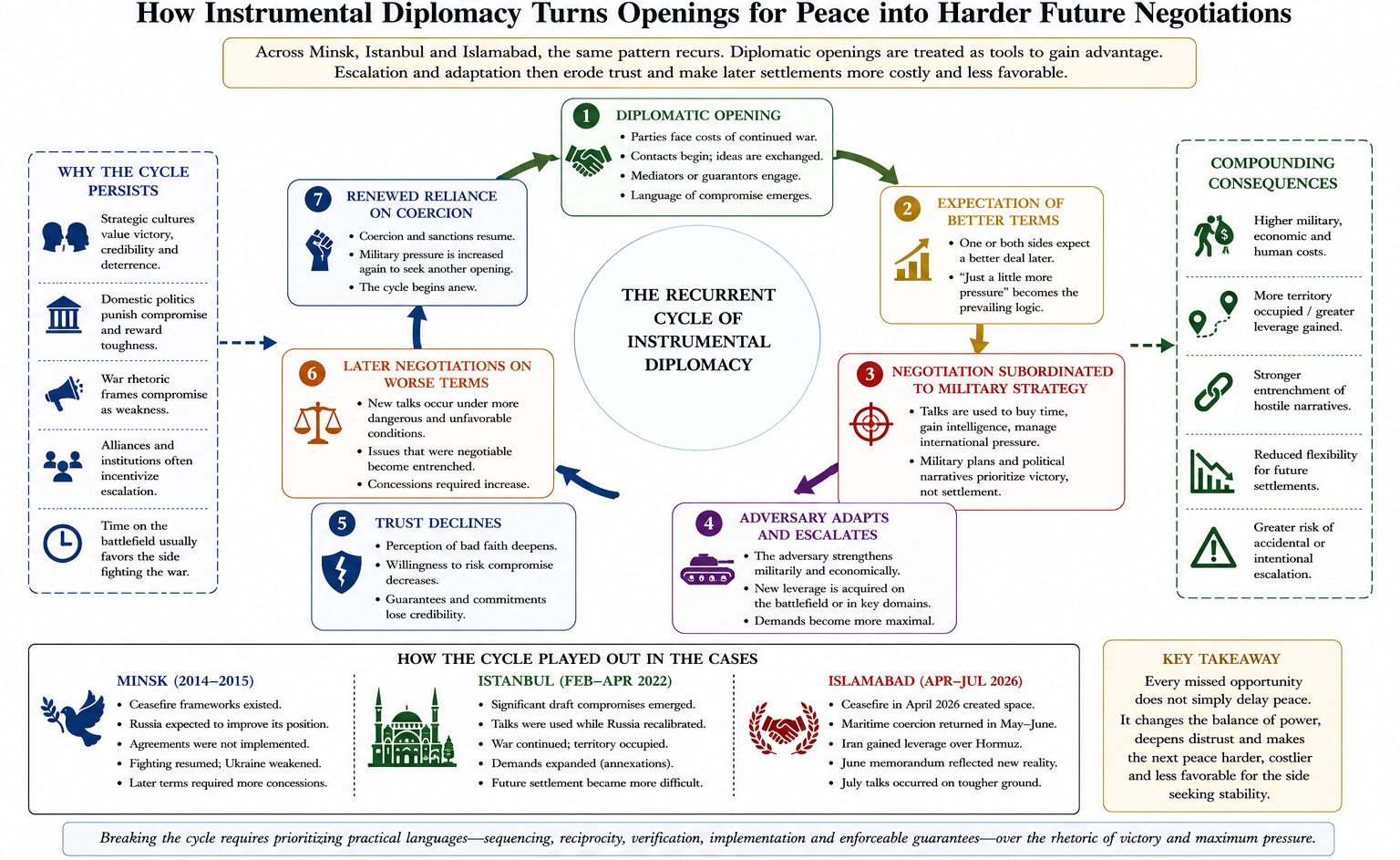
Figure 2. Onomasiology and Semasiology: Representation of the Relationship Between Term and Concept
4. MINSK I AND MINSK II: PEACE FRAMEWORKS USED AS STRATEGIC TIME
The Minsk process consisted of two principal agreements. Minsk I, concluded in September 2014, established an initial ceasefire and a preliminary framework for addressing the conflict in eastern Ukraine (OSCE 2014). Its provisions were only partially implemented, and fighting soon resumed. Minsk II, agreed in February 2015 after renewed military escalation, created a more detailed roadmap involving a ceasefire, withdrawal of heavy weapons, OSCE monitoring, local elections, constitutional reform, special status for parts of Donetsk and Luhansk, withdrawal of foreign armed formations and the eventual restoration of Ukrainian control over its international border (OSCE 2015).
The progression from Minsk I to Minsk II is important. The failure of the first agreement did not return the parties to the same negotiating position. Renewed fighting changed the territorial and military balance and required a second agreement with more elaborate political and security provisions. Minsk II was therefore already a peace initiative negotiated after an earlier opportunity had deteriorated.
The Minsk process emerged from the conflict that followed the 2014 removal of Ukrainian president Viktor Yanukovych, Russia’s annexation of Crimea and the armed uprising in parts of Donetsk and Luhansk. Russia supported the self-proclaimed Donetsk and Luhansk republics politically and militarily. Germany and France represented the principal Western European powers supporting Ukraine within the Normandy Format.
Minsk II did not fail because it lacked a roadmap. It failed because the parties did not agree on the political destination or the sequence required to reach it. Kyiv regarded the agreement as a mechanism for containing the conflict, ending Russian intervention and restoring sovereignty. Moscow and the Donbas authorities emphasized constitutional reform, special status and elections before Ukraine recovered complete control of the border. Kyiv feared that these provisions would embed permanent Russian influence inside Ukraine. Moscow argued that Kyiv intended to recover the territory while avoiding the political concessions promised to the Donbas.
The central dispute was therefore one of sequencing. Should border control precede elections, or should elections and constitutional reform come first? Could elections be legitimate while Russian-supported formations remained present? Could the Donbas authorities be expected to disarm before receiving enforceable guarantees of political status and physical security? These questions concerned the constitutional character, territorial sovereignty and geopolitical orientation of Ukraine.
The diplomatic alignments compounded the problem. France and Germany formally acted as mediators through the Normandy Format, but they were also members of the North Atlantic Treaty Organization (NATO) and part of the broader Western coalition supporting Ukraine. Alongside political backing and sanctions against Russia, NATO members trained Ukrainian forces, supported defence reforms and supplied equipment and other material assistance that strengthened Ukraine’s capacity over time (NATO 2026a; 2026b). Their role was therefore not strategically neutral, even while they continued to serve as diplomatic intermediaries.
Russia likewise described itself as a guarantor rather than a direct belligerent, although it remained the indispensable political, military and material sponsor of the Donetsk and Luhansk entities. The Minsk process was therefore shaped by two opposing strategic alignments: Kyiv supported by France, Germany, NATO and the broader West, and the separatist-controlled Donbas supported by Russia. This imbalance between formal mediation and actual alliance commitments made mutual confidence and neutral enforcement exceptionally difficult.
Neither side was prepared to surrender its principal leverage first. Ukraine did not implement the full political settlement demanded by Moscow and the Donbas authorities. Russia did not withdraw its support or create conditions in which Ukraine could safely recover sovereign control. Ceasefire violations continued and both the security and political provisions remained incomplete.
Later statements by three principal participants strengthened the interpretation that Minsk also functioned as a strategic holding arrangement. Angela Merkel said in 2022 that Minsk had been an attempt to give Ukraine time and that Ukraine had used that time to become stronger (Hildebrandt and di Lorenzo 2022). François Hollande agreed that the agreement halted further Russian advances and enabled Ukraine to strengthen its armed forces (Prouvost 2022). Petro Poroshenko was more explicit, stating that Minsk gave Ukraine years to rebuild its military, economy and state institutions (European Solidarity 2022). These statements do not prove that Minsk was conceived solely as a coordinated deception. A ceasefire may genuinely reduce violence while also allowing a vulnerable state to strengthen itself. Russia likewise used the period instrumentally by sustaining the Donbas entities and preserving leverage over Ukraine.
The more important conclusion is that each participant valued Minsk for a different strategic purpose. For Ukraine and its Western supporters, the agreements contained the conflict and created time to strengthen the Ukrainian state. For Russia, the unresolved status of the Donbas preserved leverage over Ukraine’s politics and geopolitical orientation. For the Donbas authorities, Minsk promised political recognition, security and autonomy. These purposes could coexist temporarily but could not produce a durable settlement without a common theory of peace.
The retrospective admissions also damaged the credibility of later diplomacy. Moscow interpreted them as confirmation that Western-supported negotiations had served as cover for Ukraine’s military development. Ukraine concluded that agreements without enforceable guarantees could preserve rather than remove Russian coercion. Minsk therefore did more than fail. It taught all parties that diplomatic language could coexist with preparation for renewed war. That lesson followed them to Istanbul.
5. ISTANBUL: THE PEACE OPENING DISPLACED BY CONFIDENCE IN VICTORY
Russia’s invasion of Ukraine on February 24, 2022, caused immense human suffering and transformed the European security order. Diplomacy nevertheless began immediately. Former Israeli prime minister Naftali Bennett travelled to Moscow as an intermediary and later said that Moscow moderated its demand for Ukrainian demilitarization while President Volodymyr Zelensky moved toward accepting that Ukraine would not join NATO. Ukrainian officials disputed parts of Bennett’s account, but the mediation confirms that substantive bargaining occurred during the war’s opening weeks (Associated Press 2023).
At Istanbul on March 29, Ukraine proposed permanent neutrality, the exclusion of foreign military bases and continued eligibility for European Union membership in exchange for binding international security guarantees. Crimea and the Donbas would be handled separately. Russia provisionally engaged with the framework, and later draft exchanges narrowed several disagreements, although territory, force levels and the activation of guarantees remained unresolved (Office of the President of Ukraine 2022a–c; Charap and Radchenko 2024).
The movement of Russian forces away from Kyiv should not be reduced either to an uncontested Russian battlefield defeat or to a purely voluntary diplomatic gesture. Ukrainian resistance and Russian operational difficulties clearly influenced Moscow’s calculations. The withdrawal also coincided with progress in negotiations and with Russia’s announcement that it would reduce operations near Kyiv to facilitate diplomacy. Overlapping military and negotiating motives are more plausible than either side’s exclusive narrative. The withdrawal created an opening. Much of the immediate pressure on Kyiv had been removed, Ukraine had demonstrated its ability to resist and both sides had begun identifying possible trade-offs. This was the moment to define the proposed guarantees, sequence Russian withdrawals and test whether neutrality could be made enforceable.
Instead, the political environment moved in the opposite direction. The killings in Bucha deepened Ukrainian anger and distrust. At the same time, Western governments became increasingly confident that weapons, sanctions and Ukrainian resistance could impose a strategic defeat on Russia. Boris Johnson visited Kyiv on April 9. Zelensky publicly said that he had briefed the British prime minister on negotiations and hoped Britain would contribute to peace. Later reporting by Ukrainska Pravda, citing sources close to Zelensky, stated that Johnson conveyed two broader messages: Vladimir Putin should be pressured rather than accommodated, and Western governments were not prepared to join the proposed settlement even if Ukraine wished to proceed. Ukraine’s chief negotiator, Davyd Arakhamia, later said that neutrality was Russia’s central demand and that Johnson advised Ukraine to continue fighting. Arakhamia also cited Ukrainian distrust, constitutional difficulties and inadequate guarantees. Johnson’s intervention was therefore significant, but it was not the sole explanation for the talks’ collapse (Office of the President of Ukraine 2022d; Ukrainska Pravda 2022; Vedomosti 2023).
The lost opportunity lay not in the abandonment of a completed treaty, but in the failure to develop the diplomatic track with the same urgency as the military one. The United States and Europe rapidly organized sanctions, weapons transfers, intelligence cooperation and financial support. They did not create a comparably serious process for defining guarantor obligations, monitoring compliance, sequencing withdrawal and specifying consequences for violations. The language of war hardened accordingly. Western policy moved from defending Ukrainian sovereignty toward weakening Russia and inflicting a strategic defeat. Negotiations were judged not against the probable costs of prolonged war but against the expectation that NATO support and economic sanctions would produce more favourable terms. That expectation failed to deliver the anticipated outcome. Russia suffered heavy losses and serious economic restrictions, but it adapted militarily, mobilized industrial capacity and expanded the territory under its control. Ukraine preserved its statehood but incurred devastating demographic, territorial, infrastructural and economic damage. The terms discussed at Istanbul did not remain available indefinitely.
During the spring 2022 negotiations, the principal territorial question concerning the Donbas was still framed largely around the status, security and degree of autonomy of the Donetsk and Luhansk republics, alongside separate discussion of Crimea. Russia had recognized the two Donbas republics as independent shortly before the invasion, but it had not yet announced their annexation or the annexation of the occupied parts of Kherson and Zaporizhzhia. Only after the Istanbul process had collapsed and the war had continued for several more months did Moscow move toward formal incorporation. In September 2022, Russian-backed authorities organized referendums in Donetsk, Luhansk, Kherson and Zaporizhzhia, and on September 30 President Vladimir Putin proclaimed their annexation into the Russian Federation. The United Nations rejected the referendums and annexation claims as illegal and without legal effect (United Nations 2022a; 2022b). The change marked a substantial hardening of Russia’s territorial position: a dispute that had earlier involved autonomy, recognition and negotiated status had evolved into an explicit Russian claim of sovereignty over four Ukrainian regions. Istanbul was therefore a consequential missed opportunity. An uncertain peace was compared with the expectation that NATO support, sanctions and battlefield pressure would impose a strategic defeat on Russia. Instead, the continuation of war produced more extensive Russian territorial claims and made any later settlement more costly and less favourable to Ukraine and its Western supporters.
6. FROM THE JCPOA TO NEGOTIATIONS INTERRUPTED BY WAR
The Iran case began with an earlier loss of diplomatic credibility. The 2015 Joint Comprehensive Plan of Action was negotiated under the Obama administration by Iran, the United States, the other permanent members of the United Nations Security Council, Germany and the European Union. It imposed restrictions, inspections and monitoring on Iran’s nuclear program in exchange for sanctions relief. Critics argued that it did not adequately address ballistic missiles, Iran’s regional alliances or the eventual expiration of some restrictions. Supporters regarded it as a limited but verifiable agreement that constrained Iran’s nuclear activities more effectively than sanctions or military threats alone.
On May 8, 2018, President Donald Trump withdrew the United States from the JCPOA and restored sanctions. The Trump administration argued that the agreement did not permanently close Iran’s pathways to a nuclear weapon and failed to address its missile program and regional conduct (Trump 2018). The strategic consequences extended beyond the merits and limitations of the agreement. Iran learned that a negotiated arrangement reached with one American administration could be repudiated by the succeeding administration even when the other international participants continued to support it. Washington could withdraw from an existing settlement, reimpose economic pressure and then demand a broader bargain under harsher conditions. Any later Iranian government considering an agreement with Washington therefore had reason to ask whether promised sanctions relief and security commitments would survive a presidential transition.
The credibility problem deepened in 2025. After Trump returned to office, the United States and Iran began a new series of indirect nuclear negotiations mediated by Oman. Five rounds had taken place, and a sixth was scheduled for June 15 in Muscat. Important differences remained, but the diplomatic process had not been declared exhausted. Israel launched a large-scale attack on Iran on June 13, two days before the scheduled meeting. The strikes targeted nuclear installations, military facilities, senior commanders and nuclear scientists. Iran argued that negotiations had become meaningless while it was being attacked, and Oman subsequently announced that the June 15 meeting would not take place. Trump told Reuters that he and his team had known the Israeli attack was coming but still believed an agreement remained possible (Reuters 2025a; Reuters 2025b). The White House initially described the Israeli operation as unilateral while emphasizing that Washington had taken steps to protect American forces (White House 2025a).
The United States then entered the conflict directly, striking the Fordow, Natanz and Isfahan nuclear facilities on June 21–22. A ceasefire followed on June 24. Trump described the confrontation as the “12-Day War” and maintained that the American strikes had obliterated Iran’s principal nuclear facilities (Reuters 2025c; White House 2025b). The strategic significance of this sequence was not limited to the physical damage. From Tehran’s perspective, diplomacy had twice failed to provide protection from coercion. The United States had first abandoned the JCPOA after Iran accepted nuclear restrictions and international monitoring. It later continued negotiating while aware that Israel was preparing an attack, and then joined the military campaign before the diplomatic process had formally ended.
Whether Washington considered the 2025 talks stalled, inadequate or unlikely to succeed does not remove the credibility problem. Another meeting was scheduled, and the process had not been tested to exhaustion. Resorting to force before that round reinforced the Iranian belief that negotiation might coexist with military preparation rather than provide a genuine alternative to it. By 2026, therefore, the United States and Iran were negotiating after two distinct diplomatic ruptures: the 2018 withdrawal from the JCPOA and the interruption of the 2025 nuclear talks by the war Trump later named the “12-Day War.” Against that background, the United States and Israel began a broader direct military campaign against Iran on February 28, 2026. Official American statements emphasized Iran’s nuclear pathway, missile and drone forces, naval power and capacity to project force beyond its borders (White House 2026a; 2026b).
Four principal objectives emerged:
- preventing Iran from producing a nuclear weapon;
- destroying or permanently degrading its long-range missile and drone capabilities;
- eliminating its capacity to threaten the Strait of Hormuz; and
- severing support for allied governments and armed organizations in Yemen, Lebanon, Syria, Gaza and Iraq.
Regime change did not appear consistently as a formally declared military objective, but it remained an evident aspiration within parts of the American-Israeli coalition. The problem was not merely that these goals were ambitious. They were difficult to define or verify. Nuclear facilities can be destroyed without eliminating scientific knowledge. Missiles can be depleted while production disperses. Naval vessels can be sunk while mines, drones and coastal missiles continue to threaten shipping. Regional networks can be weakened without removing the political conditions that sustain them. A state can lose commanders and infrastructure without its government collapsing.
The language of “crushing,” “annihilating” and “obliterating” the Iranian threat therefore created a standard of success that military action could damage but not conclusively satisfy. By late July, Iran still possessed the ability to strike regional targets and disrupt maritime activity. American and allied facilities had been exposed to sustained retaliation. American and allied bases were attacked, and some facilities were damaged or degraded. Although the full extent of the damage remained contested, the regional architecture supporting attacks on Iran was demonstrably vulnerable. Iran did not need to defeat the United States conventionally. It needed to demonstrate that American military superiority could not produce its political objectives without major reciprocal costs. The progression from the JCPOA to the 2025 war and then to the broader 2026 campaign is therefore central to the article’s argument: each resort to coercion was expected to secure a more comprehensive outcome, yet each damaged the credibility required for the next negotiation.
7. ISLAMABAD: THE FIRST LOST OPENING IN THE IRAN WAR
By early April, the conflict had become centred on the Strait of Hormuz. Iran restricted maritime passage, while the United States threatened greater destruction unless navigation resumed. Pakistan developed a two-stage proposal combining an immediate ceasefire with negotiations toward a broader settlement and became a principal channel between Washington and Tehran (Reuters 2026a; 2026b). On April 7, Trump accepted a two-week ceasefire shortly before the expiration of an American deadline. Pakistani prime minister Shehbaz Sharif and Field Marshal Asim Munir played central mediating roles (Reuters 2026c; 2026d). The ceasefire did not resolve the nuclear dispute, missile capabilities, regional alliances or the legal status of the Strait. It nevertheless demonstrated that both governments could step back when the costs of escalation became sufficiently high.
The language used to describe the pause shaped what followed. Pakistan framed it as space for diplomacy. The White House portrayed it as proof that overwhelming force had compelled Iran to seek relief and declared that the Iranian threat had been crushed (White House 2026c). The difference was strategic. Pakistan’s language permitted reciprocal de-escalation. The language of unilateral victory converted Iran’s acceptance of a ceasefire into evidence that additional pressure would produce additional concessions. Instead of treating the pause as the beginning of bargaining, Washington treated it as validation of coercion.
The Islamabad negotiations ended without a comprehensive agreement. The United States then imposed or reinforced a blockade of Iranian ports while demanding broader passage through Hormuz (Reuters 2026e; White House 2026d). Iran maintained its own restrictions. One blockade was layered over another. The first major peace opening was therefore reduced to an operational pause. Each side used the interval to improve its leverage rather than institutionalize restraint. The immediate consequence was resumed conflict. The strategic consequence was worse for the United States: Iran learned that control over Hormuz could compensate for conventional inferiority and force Washington to negotiate over maritime access.
8. HORMUZ AND THE JUNE MEMORANDUM: A SECOND OPPORTUNITY ON WORSE TERMS
The Strait of Hormuz gave Iran what may be called strategic equalization through systemic leverage. Iran could not match American aircraft, naval tonnage, logistics or surveillance. It could, however, threaten a narrow passage essential to energy markets, insurers, shipping companies and states far beyond the immediate war. This did not make Iran conventionally stronger. It made the economic and political costs of defeating Iran harder to contain. American forces could destroy targets but could not easily guarantee the safe, predictable and inexpensive operation of the regional energy system. Military superiority did not produce maritime normality.
Iran consequently converted Hormuz from a latent deterrent threat into a demonstrated bargaining instrument. A war partly intended to destroy Iran’s ability to close the Strait instead confirmed the centrality of that capability to Iranian security strategy. On June 15, American officials announced a memorandum of understanding intended to end the war and restore shipping gradually through Hormuz (Reuters 2026g). The agreement was a second strategic opening, but it emerged on terms less favourable to Washington than those available in April. Iran now sought relief from the American blockade and recognition of a post-war role in regulating maritime access. The United States demanded safe and substantially unrestricted passage before relinquishing coercive leverage.
Disputes over routes near Oman exposed the same sequencing problem that had undermined Minsk. Washington treated alternative lanes and ship-transfer arrangements as necessary protection for commerce. Tehran regarded unapproved traffic as a violation of the emerging arrangement and a challenge to its authority. Iranian attacks on ships and American retaliation restored tit-for-tat warfare. By late July, the United States had again paused intensified bombing while indirect diplomacy resumed. Oman advanced a Gulf-supported proposal that contemplated an Iranian role, including voluntary service fees, in the management of Hormuz (Reuters 2026f; 2026h).
The progression is central to the article’s thesis. In April, the United States sought restoration of navigation. By July, mediators were discussing arrangements that could recognize a continuing Iranian role in administering access. The missed April opportunity had not preserved the earlier terms. It had allowed Iran to demonstrate leverage and demand more. The June memorandum also carried the accumulated burden of the JCPOA withdrawal and the failed April process. Iran had reason to doubt that American restraint would survive a change in calculation. Washington believed Iran would exploit any pause to rebuild. Neither side wished to implement first. Without agreed answers on shipping routes, inspections, blockade relief, territorial waters, verification and remedies for violations, each operational decision could be described as defensive by one side and aggressive by the other. The language of implementation again became the language of betrayal.
9. THE COMPARATIVE PATTERN: EVERY LOST PEACE WORSENED THE WESTERN POSITION
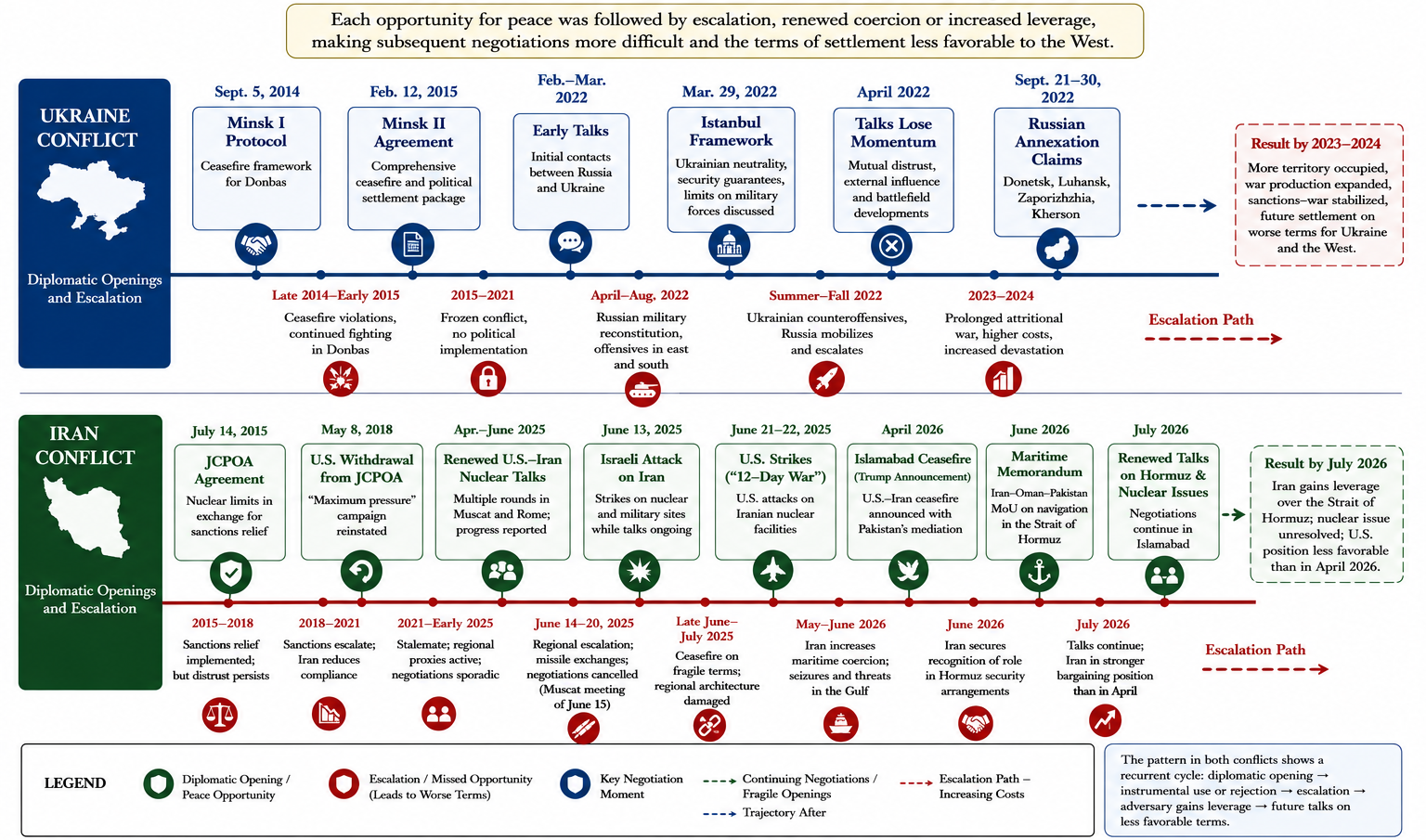
The three cases reveal a consistent sequence:
- First, a diplomatic opening emerged before either side had achieved decisive victory. Minsk contained the Donbas war; Istanbul identified possible compromises on neutrality and guarantees; the JCPOA constrained Iran’s nuclear program; the 2025 talks reopened a diplomatic channel; Islamabad produced a ceasefire, followed later by the June maritime framework.
- Second, Western planners or Western-aligned actors concluded that continued pressure might produce better terms. Minsk gave Ukraine time to strengthen. At Istanbul, confidence shifted toward NATO support, sanctions and Russian strategic defeat. Washington abandoned the JCPOA, accepted military action while the 2025 talks were still active and, after the April 2026 ceasefire, intensified maritime coercion in the expectation that Iran would concede more.
- Third, the adversary adapted. Russia reorganized its economy, expanded military production, deepened non-Western partnerships and occupied more territory. Iran dispersed capabilities, exposed the vulnerability of American regional bases and turned Hormuz into an instrument of systemic leverage.
- Fourth, the terms of later negotiation worsened for the West. Russia’s later demands exceeded the compromises discussed at Istanbul. Iran’s later bargaining position included a demonstrated ability to disrupt Hormuz and proposals recognizing some role in its administration.
- Fifth, Western costs accumulated. Ukraine suffered losses that no later agreement could reverse. Europe absorbed higher security and economic burdens. The United States faced munitions pressures, strategic overstretch and reduced diplomatic credibility. Russia and Iran also suffered enormous losses, but the wars did not achieve the comprehensive transformation promised by Western rhetoric.
This is the central asymmetry. Russia and Iran did not need to win in an absolute sense. They needed to survive, adapt and make the price of Western objectives progressively higher. Once the West defined success as strategic defeat, regime weakening or permanent military degradation, adversarial survival itself became a strategic achievement.
The repeated portrayal of Russia and Iran as both weak and existentially dangerous reinforced this dynamic. Their supposed weakness made victory appear close, while their alleged danger made negotiation appear irresponsible. Enemy failures justified continued pressure; enemy successes justified escalation. The discourse therefore contained no natural endpoint.
Each lost peace opportunity was compared with an idealized victory. Minsk was judged against complete Ukrainian restoration without Russian influence. Istanbul was judged against a future Russian strategic defeat. The JCPOA, the 2025 talks and the April and June 2026 processes were judged against progressively broader objectives: nuclear disarmament, missile destruction, unrestricted navigation, severed regional alliances and possible regime change.
The proper comparison was different. Istanbul should have been assessed against the settlement likely to remain after years of destruction, not against complete Ukrainian victory. The 2025 negotiations should have been assessed against the dangers of replacing an incomplete bargain with war, and the April 2026 ceasefire against the more demanding Hormuz settlement Washington would face after Iran had demonstrated its leverage. The recurring strategic error was therefore temporal as much as military: negotiators assumed that an imperfect peace could be postponed without changing its price.
10. PARALLEL STRATEGIC CULTURES AND THE LANGUAGE OF COERCIVE TRANSFORMATION
The coalitions in the two wars were not identical. Ukraine was an independent state resisting invasion while relying heavily on the United States and Europe. In the Iran war, Israel and the United States were the principal military planners, with Gulf states shaping logistics, basing and mediation. The strategic cultures nevertheless shared four assumptions:
- The first was confidence in escalation management: superior intelligence, precision weapons and alliance coordination would allow pressure to rise without uncontrollable retaliation.
- The second was confidence in cumulative degradation: destruction would reduce the adversary’s capacity faster than it could adapt or rebuild.
- The third was confidence in political fracture: casualties, sanctions and economic hardship would weaken the governing system and alter its policy.
- The fourth was confidence in negotiation after dominance: diplomacy would become useful after the adversary had lost the ability to reject Western terms.
These assumptions are especially dangerous against large, politically mobilized and strategically resilient states. Russia possesses nuclear weapons, industrial depth, resources and territory. Iran possesses a large population, difficult geography, dispersed infrastructure, missile capacity and leverage over regional trade routes. Neither is an adversary whose resistance ends when a target list has been exhausted. The shared strategic error is best described as coercive transformation supported by instrumental diplomacy. Negotiations are offered, but the adversary is asked to exchange permanent strategic concessions for guarantees that are limited, reversible or politically uncertain. From Moscow’s or Tehran’s perspective, diplomacy then appears to be an effort to obtain through sequencing what military force has not yet secured.
Once that perception dominates, compliance becomes a vulnerability and retaliation becomes self-justifying. A ship is attacked and credibility requires a response. A base is struck and deterrence demands escalation. Political purpose disappears behind an endless duty to answer the previous attack. Credibility, however, is not an independent national interest. A state can maintain a reputation for retaliation while worsening its bargaining position. It can answer every attack while increasing the adversary’s leverage, depleting its own resources and making later diplomacy more expensive.
11. TOWARD A LANGUAGE OF STRATEGIC PEACE
A more credible language of peace would begin by distinguishing military damage from political success. Destroying targets may reduce capabilities, but it does not by itself create an enforceable order. War aims must also be limited and verifiable. Preventing nuclear weaponization through monitored restrictions is negotiable. Eliminating every form of knowledge or infrastructure relevant to nuclear development is potentially endless. Protecting Ukraine through guarantees is definable. Transforming Russia into a permanently weakened power is not.
Reciprocal security must be acknowledged without creating false moral equivalence. Russia’s invasion can be condemned while recognizing that a settlement must address the relationship among Russia, Ukraine and NATO. Iran’s coercive conduct can be opposed while recognizing that no durable agreement is possible if Tehran believes it remains permanently exposed to attack. Mediators must be empowered to construct mechanisms, not merely transmit messages. Türkiye, Pakistan, Oman and international institutions can facilitate talks, but durable agreements require sequencing, verification, adjudication and predetermined consequences for violations. Leaders should also avoid presenting every ceasefire as enemy surrender. Humiliation may strengthen domestic messaging but weakens implementation by making compromise politically costly for the other party.
Most importantly, negotiations must be judged against the likely future produced by continued war. An agreement should not be rejected merely because it falls short of ideal victory. The relevant question is whether the next available agreement is likely to be better or worse after the adversary has had more time to adapt.
12. CONCLUSION: PEACE RETURNS LATER AT A HIGHER PRICE
Minsk, Istanbul and Islamabad were neither perfect nor guaranteed pathways to peace. Minsk contained incompatible expectations about sovereignty and sequencing. Istanbul left unresolved questions concerning territory, force levels and security guarantees. Islamabad could not alone resolve the nuclear dispute, Iran’s regional alliances or the future governance of the Strait of Hormuz. Their imperfection does not make their loss inconsequential.
Minsk contained the Donbas conflict but was also used as strategic time. Its failure depleted trust and made later guarantees harder to design. Istanbul produced meaningful compromises at a moment when Russian forces were withdrawing from around Kyiv and Ukraine had demonstrated its capacity to resist. Rather than developing that opening with the same urgency devoted to sanctions, weapons and military planning, Western policy increasingly trusted in NATO assistance, economic pressure and the possibility of imposing a strategic defeat on Russia. The result was a longer war, greater Ukrainian devastation, stronger Russian bargaining power and less favourable conditions for any later settlement.
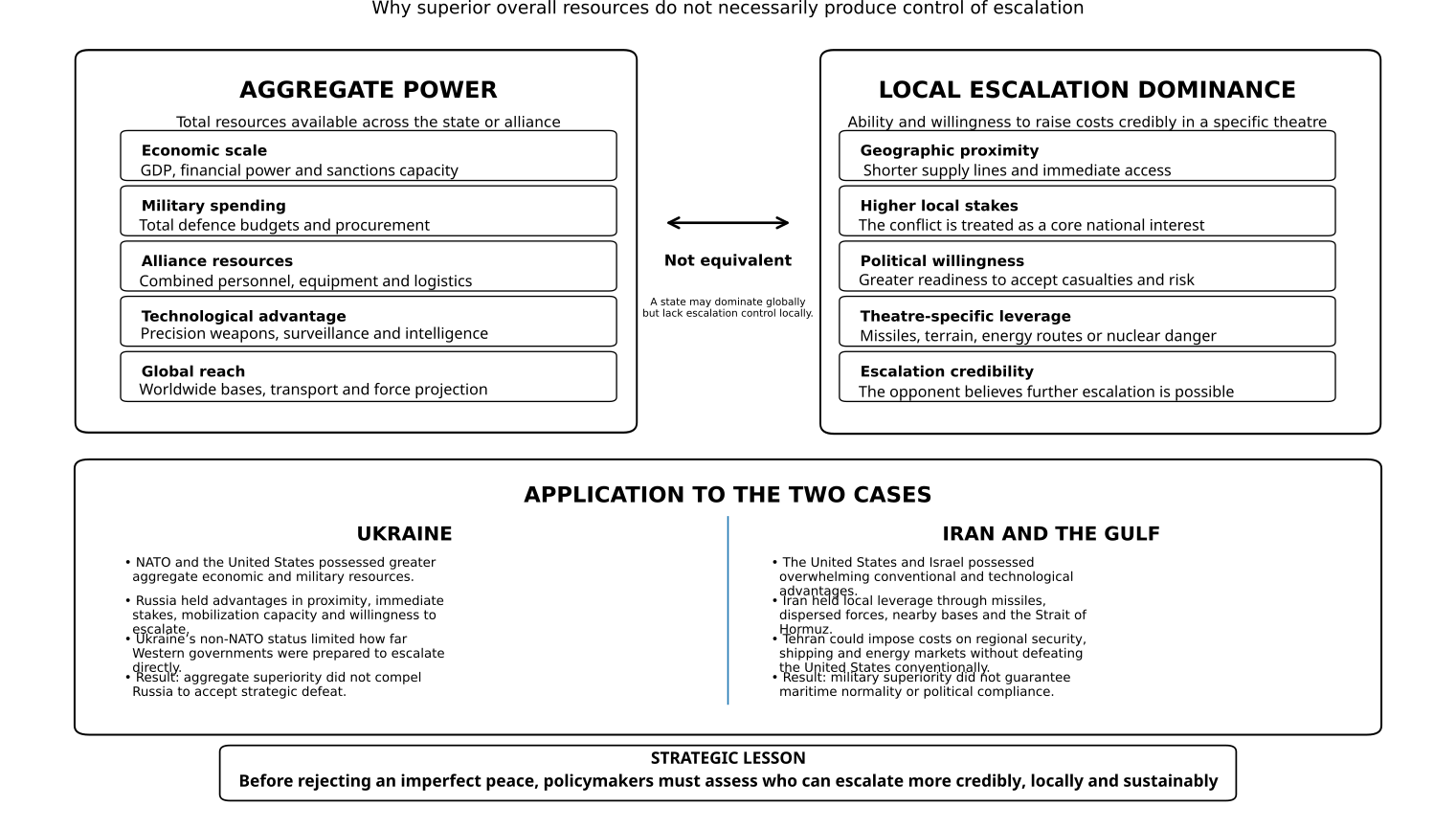
One explanation for this miscalculation was the failure to distinguish aggregate power from escalation dominance. The United States and NATO possessed far greater combined economic and military resources than Russia, but this did not mean that they could control every stage of escalation in Ukraine. Escalation dominance concerns which side can raise the intensity, duration or cost of a conflict more credibly at the place where it is being fought. Geography, proximity, political commitment, military readiness and the importance assigned to the disputed territory may matter more than total national power.
President Barack Obama recognized this limitation after the first phase of the Ukraine conflict. In 2016, he argued that Ukraine was a core interest for Russia in a way that it was not for the United States. Because Ukraine was not a NATO member, he maintained, it would remain vulnerable to Russian military domination and Washington had to be clear about which interests it was actually willing to defend through war (Goldberg 2016). His judgment did not endorse Russian conduct. It recognized that Moscow possessed geographical proximity, greater immediate stakes and a stronger willingness to escalate in Ukraine than the United States did.
The Biden administration and, later, the Trump administration placed greater confidence in the ability of weapons, sanctions, intelligence support and economic pressure to overcome that asymmetry. These measures imposed severe costs on Russia, but they did not remove Russia’s capacity or willingness to escalate. Moscow mobilized additional forces, reorganized its industrial economy, expanded military production and increased the territory it claimed after the collapse of the Istanbul process. NATO’s aggregate superiority did not translate into escalation dominance inside a non-NATO state bordering Russia.
A related miscalculation shaped the Iran war. The United States and Israel possessed overwhelming advantages in aircraft, surveillance, precision weapons and conventional naval power. Yet Iran held important local advantages: geographic proximity, dispersed missile forces, access to regional partners, the vulnerability of nearby American bases and influence over the Strait of Hormuz. These capabilities allowed Tehran to expand the costs of war beyond Iranian territory and beyond the immediate military contest.
The withdrawal from the JCPOA had already depleted American diplomatic credibility. The June 2025 attack while another negotiating round was scheduled deepened Iran’s belief that diplomacy could be overtaken by force before it was exhausted. Direct American strikes in the conflict Trump called the “12-Day War” added another rupture before the broader 2026 campaign began.
When Pakistan mediated the April 2026 ceasefire, Washington again had an opportunity to convert military stalemate into structured bargaining. Instead, the language of victory and renewed blockade treated the pause as proof that greater pressure would produce greater concessions. This calculation again confused conventional superiority with escalation control.
Iran could not defeat the United States in a conventional war. It did not need to do so. It needed to survive, continue striking regional military infrastructure and demonstrate that maritime and energy security could not be restored without Iranian cooperation. By using the Strait of Hormuz as an instrument of systemic leverage, Iran acquired a form of local escalation dominance: it could impose economic and political costs on the United States, its regional partners and states far removed from the battlefield.
By June and July, Washington was therefore negotiating in a less favourable environment than it had faced in April. The question was no longer simply whether Iran would reopen the Strait under American pressure. Mediators were discussing arrangements that could recognize an Iranian role in managing access. As in Ukraine, the failure to secure an earlier peace did not preserve the original terms. It allowed the adversary to acquire additional leverage.
Russia and Iran did not achieve costless or complete victories. Both suffered severe military, economic and human losses. Yet each survived, adapted and demonstrated forms of escalation dominance that Western planning had underestimated. Russia showed that NATO’s combined power could not easily compel Moscow to accept defeat in a neighbouring non-NATO state. Iran showed that American conventional superiority could not guarantee the security of regional bases, maritime traffic or global energy routes.
The West, meanwhile, accumulated obligations, munitions pressures, energy vulnerabilities and diplomatic credibility deficits without achieving the decisive transformations promised by its rhetoric. This was not primarily a failure of military technology. It was a failure to recognize the limits of military power when an adversary possesses greater local stakes, geographic advantages and a credible capacity to escalate.
The central lesson is not that peace should be accepted at any price. Some ceasefires preserve conquest, and some negotiations are pursued in bad faith. The lesson is that the decision to reject an imperfect peace must be informed by a realistic assessment of escalation dominance. Before assuming that more pressure will yield better terms, policymakers must ask which side can endure longer, which side can raise the costs more easily and which side regards the conflict as sufficiently important to accept risks that the other will not.
Peace must therefore be tested with the same seriousness as military power. A state may use an agreement to gain time. It may exploit a ceasefire to improve its position. It may abandon an existing framework and demand broader concessions. But every instrumental use of diplomacy teaches the adversary that peace is merely another theatre of war. Diplomacy eventually returns because political conflicts cannot be bombed out of existence. When it returns after a lost opportunity, however, it returns after more deaths, more destruction, stronger adversarial leverage and a higher price for the states that once believed aggregate superiority guaranteed control of escalation.
BIBLIOGRAPHY
Aito, Emmanuel, and Chidi Igwe. 2011. “Études onomasiologiques et sémasiologiques des technolectes et des unités terminologiques complexes.” Linguistik Online 46 (2). https://doi.org/10.13092/lo.46.369.
Associated Press. 2023. “Former Israeli PM: Putin Promised Not to Kill Zelenskyy.” February 5. https://apnews.com/article/4ea6bd21cb2ac96dae731ce0e8ac2f22
Charap, Samuel. 2022. “The Perilous Long Game in Ukraine: Compromising with Putin May Be America’s Best Option.” Foreign Affairs, March 30. https://www.foreignaffairs.com/articles/ukraine/2022-03-30/perilous-long-game-ukraine
Charap, Samuel, and Sergey Radchenko. 2024. “The Talks That Could Have Ended the War in Ukraine: A Hidden History of Diplomacy That Came Up Short—but Holds Lessons for Future Negotiations.” Foreign Affairs, April 16. https://www.foreignaffairs.com/ukraine/talks-could-have-ended-war-ukraine
European Solidarity. 2022. “Poroshenko on the Minsk Agreements: We Received Eight Years to Create the Armed Forces and Restore the Economy.” June 15. https://eurosolidarity.org/2022/06/15/poroshenko-pro-minski-domovlenosti-my-otrymaly-visim-rokiv-shhob-stvoryty-zsu-i-vidnovyty-ekonomiku/
Goldberg, Jeffrey. 2016. “The Obama Doctrine.” The Atlantic, April. https://www.theatlantic.com/magazine/archive/2016/04/the-obama-doctrine/471525/
Hildebrandt, Tina, and Giovanni di Lorenzo. 2022. “Hatten Sie gedacht, ich komme mit Pferdeschwanz?” Interview with Angela Merkel. Die Zeit, December 7. https://www.zeit.de/2022/51/angela-merkel-russland-fluechtlingskrise-bundeskanzler
Igwe, Chidi. 2005. Autour des approches onomasiologiques et sémasiologiques du rapport terme/concept en terminologie : vers une description des zones limitrophes. Master’s thesis, University of Regina.
Igwe, Chidi. 2012. “Aspect ontologique de la théorie onomasiologique et sémasiologique de la terminologie : études du vocabulaire du terrorisme.” La Banque des mots 83: 24–39.
Igwe, Chidi Nnamdi. 2015. “Aspects de la lexicalisation en terminologie du terrorisme.” La Banque des mots 89: 112–122.
NATO. 2026a. “NATO’s Support for Ukraine.” https://www.nato.int/en/what-we-do/partnerships-and-cooperation/natos-support-for-ukraine
———. 2026b. “Relations with Ukraine.” https://www.nato.int/en/what-we-do/partnerships-and-cooperation/relations-with-ukraine
Office of the President of Ukraine. 2022a. “During the Negotiations with Russia, the Ukrainian Delegation Officially Outlined Its Proposals for a New System of Security Guarantees for Our Country.” March 29. https://www.president.gov.ua/en/news/na-peregovorah-iz-rosiyeyu-ukrayinska-delegaciya-oficijno-pr-73933
———. 2022b. “The New Multilateral Treaty Should Make Any Aggression against Ukraine Impossible—Andriy Yermak.” March 29. https://www.president.gov.ua/en/news/nova-bagatostoronnya-ugoda-maye-unemozhliviti-bud-yaku-agres-73941
———. 2022c. “Mykhailo Podolyak: International Multilateral Treaty on Security Guarantees Will Give Ukraine Reliable Protection against Possible New Aggression.” March 30. https://www.president.gov.ua/en/news/mizhnarodnij-bagatostoronnij-dogovir-pro-garantiyi-bezpeki-d-73965
———. 2022d. “Ukraine and Great Britain Will Continue to Strengthen Anti-War Coalition—Volodymyr Zelenskyy after Meeting with Boris Johnson in Kyiv.” April 9. https://www.president.gov.ua/en/news/ukrayina-ta-velika-britaniya-j-nadali-posilyuvatimut-antivoy-74221
Organization for Security and Co-operation in Europe. 2014. “Protocol on the Results of Consultations of the Trilateral Contact Group, Signed in Minsk, 5 September 2014.” September 5. https://www.osce.org/home/123257
———. 2015. “Package of Measures for the Implementation of the Minsk Agreements.” February 12. https://www.osce.org/cio/140156
Prouvost, Théo. 2022. “Hollande: ‘There Will Only Be a Way Out of the Conflict When Russia Fails on the Ground.’” Kyiv Independent, December 28. https://kyivindependent.com/hollande-there-will-only-be-a-way-out-of-the-conflict-when-russia-fails-on-the-ground/
Reuters. 2025a. “Iran Says Talks with US ‘Meaningless’ after Israel Attack, but Yet to Decide on Attending.” June 14. https://www.reuters.com/world/middle-east/iran-says-nuclear-talks-with-us-meaningless-after-israel-attack-2025-06-14/
———. 2025b. “Sunday’s U.S.-Iran Nuclear Talks Cancelled, Oman Says.” June 14. https://www.reuters.com/world/middle-east/sundays-us-iran-nuclear-talks-cancelled-oman-says-2025-06-14/
———. 2025c. “Israel and Iran Agree on Ceasefire to End 12-Day War, Trump Says.” June 24. https://www.reuters.com/world/middle-east/israel-iran-agree-ceasefire-end-12-day-war-trump-says-2025-06-24/
———. 2025d. “What Happened the Last Time Russia and Ukraine Held Peace Talks?” May 12. https://www.reuters.com/world/europe/what-happened-last-time-russia-ukraine-held-peace-talks-2025-05-12/
———. 2026a. “Iran, US Receive Plan to End Hostilities, Immediate Ceasefire, Source Says.” April 6. https://www.reuters.com/world/china/iran-us-receive-plan-end-hostilities-immediate-ceasefire-source-says-2026-04-06/
———. 2026b. “Pakistan Seeks Two-Week Ceasefire, Extension to Trump’s Deadline on Iran.” April 7. https://www.reuters.com/world/asia-pacific/pakistan-pm-seeks-two-week-extension-trumps-deadline-iran-2026-04-07/
———. 2026c. “Trump Agrees to Two-Week Iran Ceasefire, Drops Threat to Destroy ‘Whole Civilization.’” April 7. https://www.reuters.com/world/asia-pacific/iran-defiant-eve-trumps-ceasefire-deadline-2026-04-07/
———. 2026d. “‘Talks Were Almost Dead’: Pakistan’s Last-Ditch Effort to Secure Iran War Truce.” April 8. https://www.reuters.com/world/asia-pacific/talks-were-almost-dead-pakistans-last-ditch-effort-secure-iran-war-truce-2026-04-08/
———. 2026e. “US-Iran Peace Talks End without a Deal as Delegations Leave Pakistan.” April 12. https://www.reutersconnect.com/item/wrap-us-iran-peace-talks-end-without-a-deal-as-delegations-leave-pakistan/dGFnOnJldXRlcnMuY29tLDIwMjY6bmV3c21sX1ZBMTg1MDEyMDQyMDI2UlAx/dGFnOnJldXRlcnMuY29tLDIwMjY6bmV3c21sX0xWQTAwNDE4NTAxMjA0MjAyNlJQMQ
———. 2026f. “Trump Says US and Tehran Having ‘Good Talks’ as Drones Hit Iran’s Neighbours.” July 27. https://www.reuters.com/world/middle-east/iran-says-it-still-controls-strait-not-seeking-talks-after-trump-halts-bombing-2026-07-27/
———. 2026g. “U.S. Officials Say Iran Pact Signed, Hormuz Traffic Will Rise Significantly.” June 15. https://www.reuters.com/world/middle-east/trump-vance-irans-parliament-speaker-signed-mou-2026-06-15/
———. 2026h. “Oman Presents Iran with Gulf-Backed Plan for Voluntary Fees to Use Hormuz.” July 28. https://www.reuters.com/world/asia-pacific/gulf-states-back-plan-let-iran-collect-voluntary-fees-use-hormuz-2026-07-28/
Trump, Donald J. 2018. “Ceasing U.S. Participation in the JCPOA and Taking Additional Action to Counter Iran’s Malign Influence and Deny Iran All Paths to a Nuclear Weapon.” Presidential Memorandum, May 8. https://trumpwhitehouse.archives.gov/presidential-actions/ceasing-u-s-participation-jcpoa-taking-additional-action-counter-irans-malign-influence-deny-iran-paths-nuclear-weapon/
Ukrainska Pravda. 2022. “From Zelenskyy’s ‘Surrender’ to Putin’s Surrender: How the Negotiations with Russia Are Going.” May 5. https://www.pravda.com.ua/eng/articles/2022/05/05/7344096/
United Nations. 2022a. “Secretary-General’s Remarks to the Press on the Russian Decision on Annexation of Ukrainian Territory.” September 29. https://ukraine.un.org/en/201445-secretary-general-remarks-press-russian-decision-annexation-ukrainian-territory
———. 2022b. “With 143 Votes in Favour, General Assembly Adopts Resolution Condemning Russian Federation’s Annexation of Four Eastern Ukraine Regions.” October 12. https://press.un.org/en/2022/ga12458.doc.htm
Vedomosti. 2023. “Arakhamia Discussed Johnson’s Role in the Breakdown of Negotiations between Russia and Ukraine.” November 24. https://www.vedomosti.ru/politics/news/2023/11/24/1007654-arahamiya-rasskazal-o-roli-dzhonsona
White House. 2025a. “Statement from Secretary of State Marco Rubio.” June 12. https://www.whitehouse.gov/briefings-statements/2025/06/statement-from-secretary-of-state-marco-rubio/
———. 2025b. “Iran’s Nuclear Facilities Have Been Obliterated—and Suggestions Otherwise Are Fake News.” June 25. https://www.whitehouse.gov/releases/2025/06/irans-nuclear-facilities-have-been-obliterated-and-suggestions-otherwise-are-fake-news/
———. 2026a. “Operation Epic Fury: Decisive American Power to Crush Iran’s Terror Regime.” March. https://www.whitehouse.gov/releases/2026/03/operation-epic-fury-decisive-american-power-to-crush-irans-terror-regime/
———. 2026b. “President Trump’s Clear and Unchanging Objectives Drive Decisive Success against Iranian Regime.” April. https://www.whitehouse.gov/releases/2026/04/president-trumps-clear-and-unchanging-objectives-drive-decisive-success-against-iranian-regime/
———. 2026c. “Peace Through Strength: Operation Epic Fury Crushes Iranian Threat as Ceasefire Takes Hold.” April 8. https://www.whitehouse.gov/releases/2026/04/peace-through-strength-operation-epic-fury-crushes-iranian-threat-as-ceasefire-takes-hold/
———. 2026d. “President Trump’s Powerful Leadership Highlights American Strength as Energy Dominance Delivers Global Stability.” April 14. https://www.whitehouse.gov/releases/2026/04/president-trumps-powerful-leadership-highlights-american-strength-as-energy-dominance-delivers-global-stability/
Share inside ISA Scholars
Reshare this with colleagues who follow your scholar profile.